
 EN



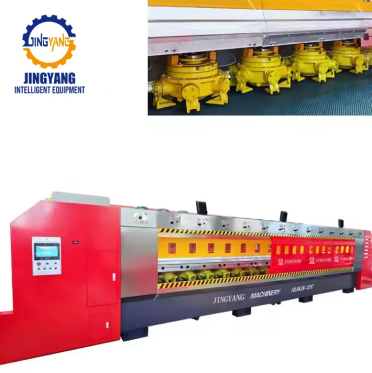
Why Gloss Consistency Breaks Down on Long Slabs
Anyone who has walked a granite slab line knows the frustration. The first stretch of slab comes off the polishing heads looking like a mirror, and then somewhere past the halfway mark, the gloss starts to drift. Maybe it gets hazier. Maybe a faint waviness appears under raking light. The slab is still polished, but it is not consistent, and that inconsistency shows up later when the fabricator tries to book-match pieces from the same bundle.
The root cause is rarely one single failure. Long slabs amplify every small variation in the system. A granite line polishing machine has to manage pressure, abrasive wear, water distribution, conveyor speed, and head alignment all at once. On a short trial piece, those variables stay close to setpoint. On a full-length slab, they have time to drift. The machine that handles this well is not necessarily the one with the most heads, but the one that keeps the process window tight from the first head to the last.
The Real Job of the Polishing Heads
A common misconception is that each head simply polishes a little more than the last. In reality, a granite line polishing machine works more like a staged mechanical sequence. Coarse heads remove saw marks and level the surface. Middle heads refine the scratch pattern. Fine heads bring up the gloss. If any stage is under- or over-performing, the downstream heads cannot fully compensate.
The key is the load on each head. Pneumatic or hydraulic pressure pushes the abrasive against the stone. If pressure is too low, the abrasive glazes over and stops cutting. Too high, and it fractures the granite crystals instead of smoothing them, which creates micro-pitting that never fully polishes out. On long slabs, the pressure has to stay within a narrow band even as the slab thickness varies slightly from end to end. That is why modern lines use floating heads with independent pressure regulation rather than a single rigid beam.
Water is another factor that gets overlooked. The slurry carries away swarf and keeps the abrasive cool. If water flow drops at one end of the line, friction heat builds up, the bond softens, and the abrasive releases too quickly. The result is a dull patch that no amount of downstream polishing can fix.
How Speed and Abrasive Selection Interact
Conveyor speed and head RPM set the dwell time. A slower pass gives each abrasive grain more time to cut, which usually improves gloss, but it also increases the risk of over-polishing a soft spot. Faster passes reduce that risk but demand more aggressive abrasives.
In practice, the goal is not the highest possible gloss reading on a meter. It is the tightest possible window from the first slab to the last. Operators running a multi-head line on a hard granite typically find that a steady, moderate pass speed gives the most uniform result across the full length of the slab. Pushing for peak gloss with a slow pass often introduces more variation along the slab, which defeats the purpose of a line polishing machine. The standard, balanced setting wins on consistency, not on a peak number, and that is a trade-off many operators learn the hard way.
Managing Abrasive Wear, Segment Transitions, and Real-World Results
Abrasive wear is progressive, not linear. A new segment cuts aggressively for the first stretch of a long run, then settles into a steady state, then dulls rapidly near the end of its life. If all heads wear at the same rate, the line stays balanced. In practice, the coarse heads wear faster because they remove more material. That shifts the scratch pattern, and the fine heads have to work harder to erase it.
The fix is not just to change abrasives more often. It is to stagger the change intervals so that no two adjacent heads are at the same wear stage. Some plants keep a simple log: head number, hours run, and a quick gloss check every shift. When the gloss from one head drifts noticeably from its neighbor, it is time to rotate or replace.
Segment transitions matter too. When a slab ends and the next one begins, the heads lift and re-engage. If the lift height or engagement speed is inconsistent, the leading edge of the new slab gets a different polish than the rest. On a long slab, that is a minor issue. On a bundle of short pieces, it becomes a visible defect. A granite line polishing machine with servo-controlled head lift and a soft-landing function handles this far better than a simple air cylinder.
A processing plant running a multi-head line on a batch of grey granite offers a useful example. The slabs were long, and the customer required a high, uniform gloss with no visible variation. In the first week, the line hit a strong gloss on the leading portion of each slab but dropped off toward the tail. The operator tried increasing pressure on the final heads. That helped the last section but created a slight orange-peel texture in the middle.
The problem turned out to be the water supply. The line had a single manifold feeding all heads, and the pressure dropped toward the far end. The last heads were getting a meaningful drop in water compared with the first. Once a secondary booster pump and a re-circulated slurry system were installed, the gloss variation across the full slab tightened into a narrow window. No change was made to the abrasives or the speed settings. The machine was capable all along. The process support system was not.
That example is a good reminder that a granite line polishing machine is only one part of the equation. Water, slurry management, and conveyor stability matter just as much.
Matching the Machine to the Material and the Market
Not every shop needs a long, high-head-count line. Soft granites and engineered stones can reach high gloss with fewer heads and less pressure. Hard granites with large crystals need more aggressive coarse heads and more careful fine polishing. The mistake is buying a line designed for one material and expecting it to handle everything.
A better approach is to define the material range first, then size the line. If the shop runs mostly thinner slabs, a narrower line with tighter head spacing works well. If it runs thicker material, the line needs more rigidity and better pressure control. The goal is not maximum speed. The goal is a gloss level that stays within a tight window from the first slab to the last slab of the day.
Manufacturers like Jingyang have focused on this balance between mechanical rigidity and process control. With deep experience in stone mining and processing machinery, the company builds lines that prioritize stable pressure, consistent water delivery, and reliable head positioning. That engineering focus shows up in the gloss consistency, not just in the spec sheet.
A Quick Check Before the Slab Leaves the Line
Even the best machine needs a simple verification step. A handheld gloss meter at a few points along the slab, head, middle, and tail, takes only a moment. If the variation stays within a tight window, the line is running well. If it is wider, the cause is usually water flow, abrasive wear, or a pressure drift on one head. Catching it early prevents a whole bundle from being reworked.
Consistent gloss on long slabs is not a mystery. It is the result of a polishing line that holds its process window and an operator who knows which variables to watch. The machine does the heavy lifting, but the process discipline makes it repeatable.