
 EN



Why Thick Steel Plates Punish Ordinary Cutting Methods
Cutting steel plate is one thing. Cutting it once the thickness climbs well past the typical range and into the very thick category is a completely different game. Thermal processes like plasma and oxy-fuel rely on heat to melt or burn through material, and that heat does not stay where it is put. It spreads. On a thick carbon steel plate, the heat-affected zone can run well beyond the surface along the cut edge, and the top and bottom of the kerf rarely behave the same way. The top edge may look clean while the bottom carries dross, a wider kerf, and a metallurgical structure that no longer matches the base plate.
That is the core problem. Thick plate amplifies every weakness a cutting method has. Distortion, taper, edge hardness, and dimensional drift all get worse as thickness increases. For fabrication shops working on pressure vessels, structural columns, or heavy machinery frames, those errors are not cosmetic. They translate into rework, fit-up problems, and sometimes rejected parts.
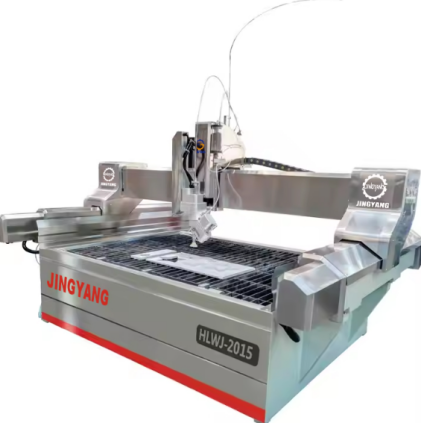
A steel waterjet cutting machine approaches the problem from a different direction. Instead of fighting heat, it removes the heat variable entirely. The result is a cut edge that stays cool, dimensionally stable, and consistent from top to bottom. That does not make it a universal answer, but for thick plate work where tolerance matters, it changes what is possible.
How a Cold Cutting Process Changes the Precision Equation
Waterjet cutting uses a high-pressure stream of water mixed with abrasive particles to erode material. There is no combustion, no melt pool, and no recrystallized zone along the cut edge. The material is mechanically removed, grain by grain, which means the metallurgy of the plate stays essentially untouched.
For thick steel, this matters in three practical ways:
No heat-affected zone means no post-cut hardness variation that can complicate welding or machining.
No thermal expansion means the plate does not move during the cut, so dimensions hold even on long, uninterrupted profiles.
No dross adhesion means the bottom edge comes off clean, reducing secondary operations like grinding or milling.
A common misunderstanding is that waterjet is only a roughing tool. On thick plate, the opposite is often true. Because the cutting forces are distributed and low, the workpiece does not need heavy clamping, and thin webs or intricate internal cutouts can be produced without the risk of thermal warping.
Jingyang's waterjet systems are engineered first for stone and hard-surface processing, then extended to metals, so the same cold-cutting discipline that protects a marble slab also protects a thick steel plate.
Abrasive Flow, Dynamic Head Control, and Taper Compensation
Precision on thick steel does not come from water pressure alone. It comes from how abrasive is delivered and how the cutting head responds to changes in material thickness and direction.
Abrasive flow rate has to stay stable. If the feed rate of garnet or another abrasive medium fluctuates, the kerf width changes, and taper becomes inconsistent. On thick plate, even a small variation in abrasive delivery shows up as a visible difference between the top and bottom of the cut.
Dynamic head control is the other half of the story. When the cutting head changes direction, the abrasive stream lags slightly behind. On thin material, that lag is barely noticeable. On thick steel, it can produce a visible taper or a rounded corner if the control system does not compensate. Modern waterjet cutting machines use closed-loop control to adjust speed, pressure, and abrasive flow in real time, keeping the kerf geometry consistent through curves, corners, and thickness transitions.
Taper is the natural enemy of thick plate cutting. The abrasive jet widens as it travels through the material, so the top of the kerf is narrower than the bottom. On a thin plate, that difference is barely perceptible. On a thick plate, it can become pronounced.
There are two ways to deal with it. The first is to slow down. A slower cutting speed reduces taper because the jet has more time to remove material evenly. The second is active compensation. The cutting head tilts slightly to counter the natural divergence of the jet, so the effective kerf stays parallel through the thickness.
The second approach is what separates a precision thick-plate cut from an acceptable one. It requires accurate knowledge of how the jet behaves at different thicknesses and materials, and it requires a machine that can adjust tilt dynamically without introducing vibration. When that is done well, the resulting edge is straight enough that minimal finishing is needed.
Comparing Waterjet Against Thermal Cutting on Heavy Plate
Criteria |
Waterjet |
Plasma |
Oxy-Fuel |
Heat-affected zone |
None |
Moderate to deep |
Deep |
Taper on thick plate |
Low with compensation |
Moderate |
High |
Edge finish |
Smooth, weld-ready |
Requires cleanup |
Requires cleanup |
Material sensitivity |
Low |
Moderate |
Low |
Cutting speed on thick plate |
Slow |
Fast |
Moderate |
Distortion risk |
Minimal |
Moderate |
High |
The table makes the trade-off clear. Waterjet is not the fastest option on thick steel. It is the one that holds tolerance and edge quality without introducing thermal damage. For shops that measure success in fit-up hours and rework rates rather than pure cutting speed, that trade is often worth making.
What Waterjet Cannot Do Well, and Why That Matters
Honesty matters more than hype. A waterjet cutting machine is not the right tool for every thick plate job. Cutting speed drops significantly as thickness increases, and on very thick sections, the process can become slow enough that thermal methods win on throughput. Abrasive consumption also adds operating cost, and the disposal or recycling of spent abrasive is a real consideration for any shop running high volumes.
There is also a practical limit to how thick a waterjet can cut efficiently. Beyond a certain thickness, the taper compensation becomes harder to control, and the cost per part rises. For very thick mild steel, the economics often favor other methods unless the edge quality requirement is unusually strict.
The takeaway is not that waterjet replaces every other process. It is that on thick steel where dimensional accuracy, edge integrity, and minimal post-processing matter, it occupies a space that thermal cutting cannot reach.
Where This Fits in a Real Fabrication Workflow
A heavy equipment manufacturer was cutting thick carbon steel plates for hydraulic press frames. Plasma cutting was fast, but the edges needed grinding before welding, and the heat input was causing enough distortion that frames occasionally needed rework after assembly. The shop switched the most tolerance-critical components to waterjet. Cutting time increased, but the grinding step disappeared, and the fit-up on the welded assemblies became predictable. The overall labor hours per frame dropped even though the cutting itself was slower.
That is the pattern that shows up again and again. Waterjet does not win on speed. It wins on what happens after the cut.
For operations that need reliable thick-plate cutting equipment, working with a manufacturer that understands both the machine and the material matters. Jingyang has built its reputation on stone and heavy-duty cutting machinery, with ISO-certified production and a supply chain that supports long-term service. The same engineering discipline that goes into quarry and stone processing equipment carries over into the precision cutting systems the company produces. For shops evaluating thick-plate cutting options, that combination of manufacturing depth and application experience is worth a closer look.
Table of Contents
- Why Thick Steel Plates Punish Ordinary Cutting Methods
- How a Cold Cutting Process Changes the Precision Equation
- Abrasive Flow, Dynamic Head Control, and Taper Compensation
- Comparing Waterjet Against Thermal Cutting on Heavy Plate
- What Waterjet Cannot Do Well, and Why That Matters
- Where This Fits in a Real Fabrication Workflow