
 EN



Quare Plati Ferrei Crassi Methodos Sectionis Ordinarias Punient
Tale de lamina de ferro est un res. Tale eam semel, cum spissitudo ascendit multum ultra ordinariam ambitum et in valde spissam categoriam intrat, est penitus aliud negotium. Processus thermici, ut plasma et oxy-combustio, in calore nituntur ut materiam fundant vel exurant, et iste calor non manet ubi ponitur. Diffunditur. In spissa lamina ferri carbonacei, zona afflicta a calore potest longe ultra superficiem prope marginem incisi extendi, et superior et inferior pars incisionis vix eodem modo se gerunt. Superior marginis pars pulchra esse potest, dum inferior pars scoriae, latioris incisionis, et structurae metallurgicae, quae iam non congruit cum lamina basi, fert.
That is the core problem. Thick plate amplifies every weakness a cutting method has. Distortion, taper, edge hardness, and dimensional drift all get worse as thickness increases. For fabrication shops working on pressure vessels, structural columns, or heavy machinery frames, those errors are not cosmetic. They translate into rework, fit-up problems, and sometimes rejected parts.
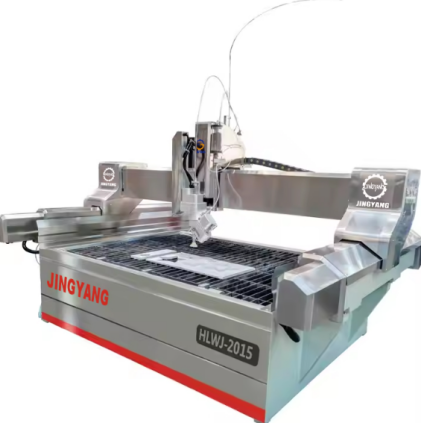
Asteel waterjet cutting machine approaches the problem from a different direction. Instead of fighting heat, it removes the heat variable entirely. The result is a cut edge that stays cool, dimensionally stable, and consistent from top to bottom. That does not make it a universal answer, but for thick plate work where tolerance matters, it changes what is possible.
How a Cold Cutting Process Changes the Precision Equation
Talea per getto d'acqua usa un flusso ad alta pressione di acqua mescolata con particelle abrasive per erodere il materiale. Non c'è combustione, nessuna zona fusa e nessuna zona di ricristallizzazione lungo il bordo tagliato. Il materiale viene rimosso meccanicamente, grano per grano, il che significa che la metallurgia della lamiera rimane essenzialmente inalterata.
Per l'acciaio spesso, questo ha tre conseguenze pratiche:
L'assenza di zona influenzata dal calore significa che non si verifica alcuna variazione di durezza dopo il taglio, cosa che potrebbe complicare la saldatura o la lavorazione meccanica.
L'assenza di espansione termica significa che la lamiera non si muove durante il taglio, quindi le dimensioni restano precise anche su profili lunghi e continui.
L'assenza di adesione di scorie significa che il bordo inferiore risulta pulito, riducendo le operazioni secondarie come la smerigliatura o la fresatura.
A common misunderstanding is that waterjet is only a roughing tool. On thick plate, the opposite is often true. Because the cutting forces are distributed and low, the workpiece does not need heavy clamping, and thin webs or intricate internal cutouts can be produced without the risk of thermal warping.
Jingyang's waterjet systems are engineered first for stone and hard-surface processing, then extended to metals, so the same cold-cutting discipline that protects a marble slab also protects a thick steel plate.
Abrasive Flow, Dynamic Head Control, and Taper Compensation
Precision on thick steel does not come from water pressure alone. It comes from how abrasive is delivered and how the cutting head responds to changes in material thickness and direction.
Abrasive flow rate has to stay stable. If the feed rate of garnet or another abrasive medium fluctuates, the kerf width changes, and taper becomes inconsistent. On thick plate, even a small variation in abrasive delivery shows up as a visible difference between the top and bottom of the cut.
Dynamic head control is the other half of the story. When the cutting head changes direction, the abrasive stream lags slightly behind. On thin material, that lag is barely noticeable. On thick steel, it can produce a visible taper or a rounded corner if the control system does not compensate. Modern machinae secturae hydroabradentis use closed-loop control to adjust speed, pressure, and abrasive flow in real time, keeping the kerf geometry consistent through curves, corners, and thickness transitions.
Taper est inimicus naturalis sectionis laminarum crassarum. Ietus abrasivus dilatatur dum per materiam transit, ita ut pars superior incisionis sit angustior quam pars inferior. In lamina tenui, haec differentia vix percipitur. In lamina crassa, potest valde apparere.
Duo sunt modi ad eam rem agendam. Primus est ut celeritas sectionis minuatur. Celeritas sectionis tardior reducit taper, quia ietus plus temporis habet ad aequabiliter materiam removendam. Secundus est compensatio activa. Caput sectionis inclinatur levi inclinatio ut divergentiam naturalem ieti contrariatur, ita ut incisio effectiva per totam crassitudinem parallela maneat.
Secundus modus est qui sectionem praecisam laminarum crassarum a sectione simpliciter acceptabili distinguit. Hoc requirit cognitionem accuratam de modo quo ietus se gerit ad diversas crassitudines et materias, et requirit machinam quae inclinatio dynamice adaptare possit sine vibratione inducenda. Cum hoc bene fit, oritur acies adeo recta ut paene nulla posttractatio opus sit.
Comparing Waterjet Against Thermal Cutting on Heavy Plate
Criteriorum |
Waterjet |
Plasma |
Oxy-Fuel |
Zona Affecta Calore |
Nullus |
Moderate to deep |
Profundus |
Taper on thick plate |
Low with compensation |
Moderatus |
Altus |
Finis Marginis |
Smooth, weld-ready |
Requires cleanup |
Requires cleanup |
Materiae Sensibilitas |
Humilis |
Moderatus |
Humilis |
Cutting speed on thick plate |
Lentus |
Celer |
Moderatus |
Periculum Distortionis |
Minimus |
Moderatus |
Altus |
The table makes the trade-off clear. Waterjet is not the fastest option on thick steel. It is the one that holds tolerance and edge quality without introducing thermal damage. For shops that measure success in fit-up hours and rework rates rather than pure cutting speed, that trade is often worth making.
What Waterjet Cannot Do Well, and Why That Matters
Honesty matters more than hype. A waterjet cutting machine is not the right tool for every thick plate job. Cutting speed drops significantly as thickness increases, and on very thick sections, the process can become slow enough that thermal methods win on throughput. Abrasive consumption also adds operating cost, and the disposal or recycling of spent abrasive is a real consideration for any shop running high volumes.
There is also a practical limit to how thick a waterjet can cut efficiently. Beyond a certain thickness, the taper compensation becomes harder to control, and the cost per part rises. For very thick mild steel, the economics often favor other methods unless the edge quality requirement is unusually strict.
The takeaway is not that waterjet replaces every other process. It is that on thick steel where dimensional accuracy, edge integrity, and minimal post-processing matter, it occupies a space that thermal cutting cannot reach.
Where This Fits in a Real Fabrication Workflow
Fabricator machinarum gravium tabulas ferri carbonis crassas praecidebat ad fabricandos cunctos pressorum hydraulicorum. Praecisio plasma celer erat, sed orae limari debebant antequam soldarentur, et calor inpositus tantum distorquebat ut interdum cuncti post coniunctionem refoverentur. Officina componenta quae maxime tolerantiis indigebant ad praecisionem aquae transierunt. Tempus praecidendi auctum est, sed gradus limandi evanuit, et aptatio in coniunctionibus soldatis praedicta facta est. Horae laboris per cunctum minuuntur, licet ipsa praecisio tardior sit.
Hoc est exemplum quod saepius apparet. Praecisio aquae non vincit in celeritate. Vincit in eo quod post praecisionem fit.
Pro operaciones quae fidam machinam ad secandum tabulas crassas requirunt, valde importat ut cum fabricante cooperetur qui tam machinam quam materiam bene intellegit. Jingyang suam famam super machinis ad secandum lapides et ad usus gravissimos aedificavit, cum productione certificata ab ISO et catena suppeditationis quae servitium longi temporis sustentat. Eadem disciplina technica quae in machinis ad excavationem et ad elaborationem lapidum impenditur etiam in systematibus ad secandum praecise quae societas producit invenitur. Pro officinis quae optiones ad secandum tabulas crassas aestimant, haec combinatio profunditatis fabricationis et experientiae in applicationibus merito diligentius consideranda est.
Index Rerum
- Quare Plati Ferrei Crassi Methodos Sectionis Ordinarias Punient
- How a Cold Cutting Process Changes the Precision Equation
- Abrasive Flow, Dynamic Head Control, and Taper Compensation
- Comparing Waterjet Against Thermal Cutting on Heavy Plate
- What Waterjet Cannot Do Well, and Why That Matters
- Where This Fits in a Real Fabrication Workflow