
 EN
EN


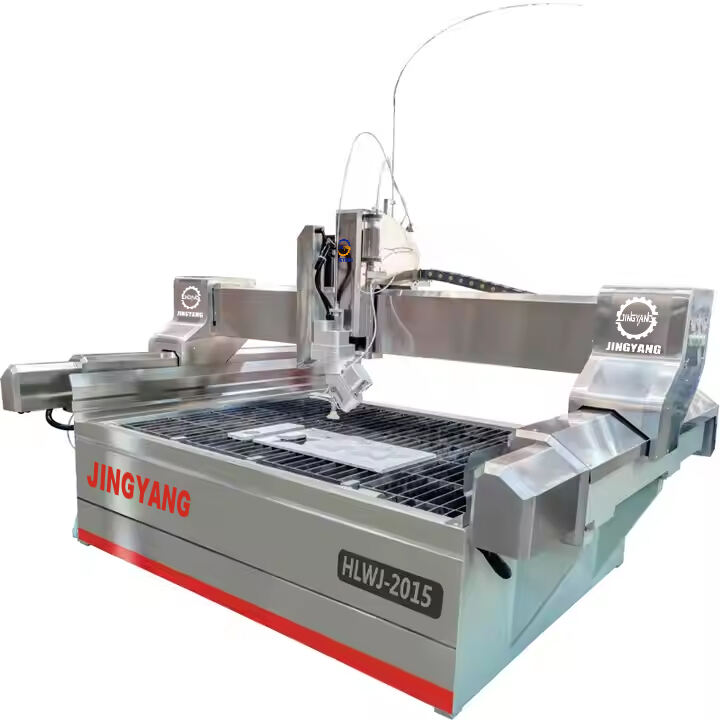
They may be overshadowed by the massive industrial cutting systems in terms of size, but the cutting power of small waterjet machines often leave the newcomers completely bewildered. These devices rely on ultra-high-pressure water — which can be sometimes be mixed with abrasive particles — to make clean and accurate cuts in a wide range of materials, thereby also saving time and costs. So what is the actual power of a small waterjet machine?
The answer to this question varies according to pressure, pump type, cutting head design and processed materials. Why don’t we find out what these machines are capable of accomplishing?
What Characterizes a Small Waterjet Machine?
A small waterjet machine is generally understood as a compact or basic waterjet cutting unit that could be installed in a workshop, a lab, a school, a research&development center or a small scale manufacturing facility. These devices normally feature:
- A smaller cutting table (frequently 600×600 mm up to 1300×1300 mm)
- Power of the pump measured in HP is lower than that of large industrial systems
- Footprint is reduced for environments where there is not much space available
- Less energy and water are consumed
Even though they are small in size, these machines still work on the same principle as big ones i.e. they utilize extremely high-pressure water - usually between 30,000 and 60,000 PSI (2,000–4,000 bar) - to perform cutting operations on materials.
Pressure: The Main Waterjet Power Factor
The real "power" of a waterjet device is not by any means determined by heat or torque but by water pressure and jet velocity. Usually, a small waterjet system is still capable of working at the following levels:
- 30,000–40,000 PSI in the case of entry-level models
- As much as 60,000 PSI for high-performance compact units
At those pressures, the amount of water discharged from the nozzle is almost three times the speed of sound. Thus, if abrasives (normally garnet) are introduced, the cutting force increases a lot. Hence, it is possible for small machines to carry out cutting of those materials which are heavy industrial equipment typically have to be used for.
Small Waterjet Machine Can Cut Material of What Type?
Small waterjet machines, with their limited housing, can still become the reason behind the user’s amazement since they can cut a wide range of materials, including:
- Metals: stainless steel, aluminum, copper, brass, titanium
- Stone and glass: marble, granite, ceramic, tempered glass
- Plastics and composites: acrylic, carbon fiber, fiberglass
- Leather and foam
- Wood and laminates
With regard to thickness, an abrasive waterjet of small size is in most cases capable of:
- Cutting steel up to 20–30 mm (0.8–1.2 inches) with a good edge finish
- Aluminum up to 40–50 mm (1.5–2 inches)
- As for softer materials, they can be even thicker than that
Furthermore, if pure water without an abrasive is used, small machines can make clean cuts of soft materials such as rubber, textiles, food products, and foam at very high speeds.
Cutting Speed: How Fast Is “Powerful”?
Even though the matter of whether a machine is capable of cutting at all is what power is mostly referred to, the question of speed is also crucial, and that is where the technology excels. Small waterjet machines can do the following:
- Cut 1–3 mm stainless steel at many meters per minute
- 10 mm aluminum at slow but steady industrial speeds
- Soft materials nearly instantaneously
Small waterjets provide more than enough speed to be able to carry out prototyping, precision work, short-run productions, and custom parts while large industrial systems are designed for continuous high-volume productions and extreme thickness.
Precision and Control
Small waterjet machines don’t only have great power; they are also very precise. With up-to-date CNC control systems, the average precision is from:
- ±0.05 mm to ±0.1 mm depending on the particular setup
Therefore, they can be employed in manufacturing:
- Components for the aerospace industry
- Parts of medical devices
- Precision gaskets and sealing elements
- Decorative metal panels
- Mechanical custom parts
Manufacturing without power is out of the question; however, this is the point where small waterjets are successful—providing controlled, repeatable cutting force.
Electrical Power Vs. Cutting Power
Most of the time, people think that a small waterjet machine means weak performance due to lower electrical input. Here is what is true:
- The electric power used by a small waterjet pump is about 15–30 kW.
- The energy is converted into very high hydraulic pressure, not heat.
- As waterjet cutting is a cooling process, there is no heat-affected zone, no metal work hardening, and no thermal distortion.
That is why even the lowest power waterjet systems are very effective when it comes to converting electrical energy into usable cutting force.
How Does It Compare to Laser or Plasma?
When individuals inquire about small waterjet machine's power, they usually intend to compare it with laser and plasma cutters.
- Compared to Laser: Small lasers may cut thin sheet metal quicker, but waterjets have the capability to cut thicker materials and can also cut reflective metals without generating heat or deforming them.
- Compared to Plasma: Although plasma cutting is fast on thick metal, it causes heat distortion and the edges are rough. On the other hand, waterjets make the metal clean with no burrs and without heating the metal.
In terms of the maximum cutting capability relative to the size of the machine, waterjets (especially abrasive ones) are among the most potent and flexible cutting techs out there.
Small Waterjet Power in Real Life
Power is essentially the result condition of usage. Small waterjet devices are prominently employed for:
- The custom metal fabricating shops
- Educational and research laboratories
- Sign-making and art studios
- Workshops of stone and tile
- Parts of the automotive and motorcycle
- Enclosures of electronics
- Aerospace prototyping
The majority of those who use such equipment are stunned by the fact that a device that can fit in a humble workshop is able to knife through stainless steel plates, ceramics tiles, or thick composites without breaking a sweat.
Small Waterjet Machines Limitations
Small waterjets, though powerful, are not without their limitations. The main ones are:
- Very low material removal rates on thick metal cutting
- A smaller working area for large parts
- Certainly, lower continuous production capacity as compared to big industrial systems
Nevertheless, these restrictions do not pose a big problem for small and medium businesses that benefit from the advantages of flexibility and cutting power instead.
So How Powerful Is a Small Waterjet Machine?
In real life scenarios, a small waterjet machine is powerful enough to accurately, cleanly, and reliably cut most industrial materials. It is a small package that contains a combination of extreme water pressure, abrasive cutting energy, and CNC precision and that can do the job of many traditional cutting tools but at a higher level.
Its first-rate output may not be of the heaviness and continuance you would expect of gigantic factory systems, but its real power is in its feature of being multi-functional, precise and having a surprising enabling authority. A small waterjet machine is a compact powerhouse and not "small" in terms of performance for workshops, startups, research centers, and custom manufacturers.