
 EN
EN



The stone processing industry has gone through significant transformation during the last decades. Technology has completely changed the working methods of marble, granite, and other natural stones processing, from old hand-operated saws to smart, computer-controlled machines.
For many stone factories, workshops, and construction suppliers, the one question that keeps coming up is:
Is a CNC marble cutting machine really better than manual cutting?
Efficiency, accuracy, costs, scalability, and business growth are only a few of the factors that come into a deciding a team. In this post, relevant comparison between manual and CNC marble cutting will be made, stone processor's real problems will be revealed, and contemporary machinery solutions such as JingYang's ones will be shown to help stone companies enhance their productivity and competitiveness.
If you run a factory that fabricates stone, a construction supplier, or a marble workshop, this manual will enable you to make a more well-considered choice of equipment.
Marble Cutting Methods: How Do They Work?
Before analyzing the two approaches for cutting marble, it is a good idea to first understand what each of them means and involves.
Manual Marble Cutting
Manual marble cutting means traditional cutting methods carried out with hand-operated or semi-mechanical tools. Below is a variety of such tools:
- Stone saws that are handheld
- Manual bridge saws
- Simple tile cutters
- Water-fed cutting blades
The cutting direction and speed are controlled manually by the operators.
Advantages of Manual Cutting
Manual cutting may still be found in many small bazaars since:
- The initial cost of the equipment is lower
- The operation is simple
- You can use it flexibly for small custom jobs
- Training requirements are minimal
Manual tools are still handy for small-scale production or repair work.
Limitations of Manual Cutting
Nevertheless, manual cutting poses a couple of serious issues:
- Low cutting precision
- Reliance on worker's skill leads to variability
- Low production speed
- Material waste
- Safety hazards
- Quality inconsistency
Nowadays, as construction works get more and more complicated and demanding, manual cutting is not capable of producing modern production outputs.
Definition of a CNC Marble Cutting Machine
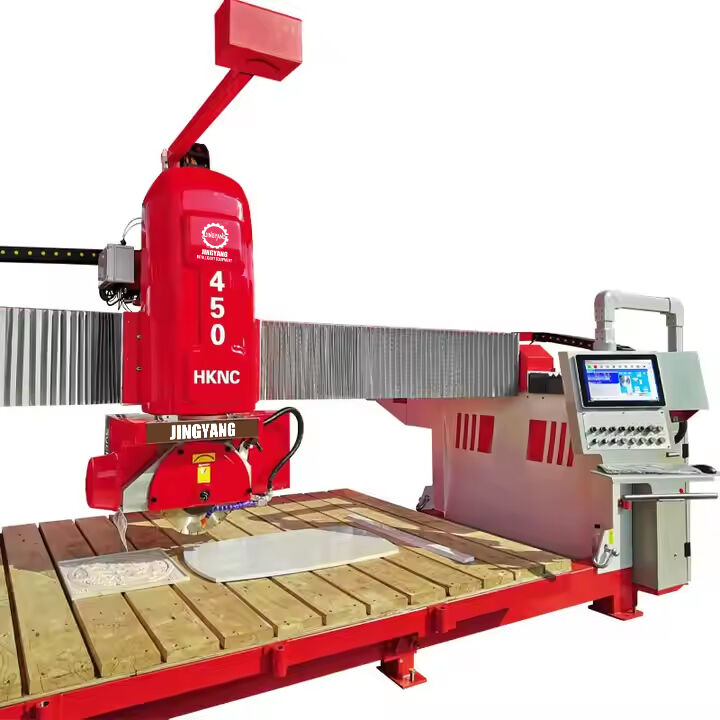
A CNC marble cutting machine is a stone cutting automated machine that operates by computer numerical control (CNC) technology.
Unlike manual operations where positioning and movement are through human intervention, the guided movements of the machine are from the cutting paths programmed in the computer and designed with CAD or CAM software.
Thus, the machine can perform accurate cuts, make curves, sculpt shapes and patterns, etc.
Below are the common components of a modern CNC marble cutting machine:
- Computer control system
- Servo motors of very high accuracy
- Cutting heads that are automatic
- Bridge structures
- Water cooling systems
- Multi-axis movement (3–5 axis)
The stone fabrication industry widely uses these machines to produce:
- Marble slabs
- Granite countertops
- Architectural stone
- Decorative stone panels
- Complex stone carvings
Stone machinery manufacturers that are advanced have unveiled CNC stone processing equipment solutions to help stone companies become more efficient and product quality-oriented.
Traditional Marble Cutting: What Are The Biggest Pain Points?
The use of manual or semi-automatic equipment still prevails among many stone factories. However, the choice results in quite a few operational problems.
Let's have a look at the pain points that most often occur
1. Lack of Consistency in the Accuracy of Cutting
Cutting manually is mostly a matter of the worker's skills. A few millimeters of a walk-away is still possible even for a seasoned worker.
Such inaccuracies usually cause:
- Non-alignment of stone slabs
- Problems during installation
- Product rejection
- Dissatisfaction of customers
At luxury and high-end level projects such as hotels, commercial buildings, and luxurious interiors, precision is the must-have.
2. Production Rate is Too Low
Manual cutting simply takes a lot of time.
First, workers have to:
- Carry out manual measurement of the raw materials
- Position the slabs with their own hands
- Modify the cutting angles
- Make sure that each cutting is safe and accurately done
Production capacity per day remains limited.
Manual cutting will undoubtedly be the bottleneck of a large-scale construction project where thousands of stone elements need to be produced.
3. Stone Processing is Expensive Due to High Labor Costs
It is really hard to find experienced and skilled stone cutters. Besides, labor charges are going up, and there is the risk of losing workers. Companies may also spend time and resources on training.
Labor dependency is what automation helps eliminate.
4. High Material Waste
An uneven edge, wrong dimension, slab breakage, are all common consequences of manual cutting.
Stone materials are not cheap, and the mistake of a few centimeters can lead to big losses.
5. Concerns about Workplace Safety
Operation of stone cutting includes the handling of heavy materials, while the blades are running at very high speeds which results in greater risks if manually operated such as:
- Worker injuries
- Blade accidents
- Dust exposure
- Fatigue-related mistakes
Modern CNC machinery provides safer working conditions through the automation of control and by installing protective systems.
Ways By Which CNC Marble Cutting Machines Address These Problems
Quite a few of modern CNC machines' features were designed to address the challenges of traditional cutting methods.
Here is how.
1. Very High-Level Precision Cutting
CNC machines can follow a digital set of commands with very high precision.
Most often the degree of precision reaches:
±0.1 mm or even a bit better
The outcome is, therefore:
- Stone that is the exact desired size
- Gladly edges
- Correct angles
- Accurate reproduction of a pattern
Every architectural project is such that stone parts must fit perfectly, a kind of precision like that is simply imperative.
2. Way Faster Production
Continuous cutting operations can only be made possible through automation.
Besides, a CNC machine can:
- Position materials on its own
- Follow multiple cutting paths
- Do multi-step cutting operations in a single cycle
Production efficiency after switching from manual to CNC machine can be 200–400% higher.
Factories that heavily deal with stone slabs will see their revenues go up right after seeing the impact of such a productivity change.
3. Decreased Labor Requirements
Fewer operators will be needed by CNC machines.
The stone actually being cut manually by several workers will be limited to one technician who only supervises the entire machine.
Among the advantages are:
- Less money paid for labor costs
- Less staff training
- More stable and reliable functioning
Especially in the markets where skilled workers are scarce, this comes as a great advantage.
4. More Efficient Use of Materials
The software of a CNC machine calculates the best way to nest cutting patterns.
This enables the:
- Constraint free slab utilization
- Reduction of waste
- Improvement of the nesting
When dealing with highly priced any imported marble, even saving a few percent of the raw material goes a long way in increasing the profitability.
5. Safer Working Conditions
CNC machines nowadays are equipped with safety features such as:
- The emergency stop button
- Protective guards
- Automated blade changes
- Excellent handling of dust and water
Such features lead to fewer accidents and better safety in the workplace.
JingYang Provides Real Industry Solutions
Those wondering where to find reliable equipment suppliers when deciding to upgrade manual cutting most often search the Web.
JingYang is an example of a professional manufacturer of stone machinery with more than 35 years of industry experience.
The company facts provided at their official site are:
https://www.stonemachinerypro.com/about-us
JingYang now operates as a full-range stone machinery manufacturer focusing on:
- Research and development
- Equipment manufacturing
- Worldwide sales
- Technical assistance
It works out of a 50,000-square-meter production facility and has over 260 technical personnel engaged in advancing the technology of stone processing.
Innovation and Technical Background
The firm continually invests in the development of new technologies.
Currently, they own a variety of patents related to innovations in stone machinery and actively participate in research activities together with universities.
This allows them to continuously come up with revolutionary equipment such as:
- CNC bridge saws
- Multi-axis stone cutting machines
- Automated stone processing systems
- Waterjet cutting equipment
Built to raise cutting accuracy, speed, and reliability of operation.
Compliance with International Quality Standards
JingYang commits to strict quality control practices to guarantee their products' reliability.
They manufacture their equipment compliant with worldwide certificates such as:
- ISO 9001 quality management
- ISO 14001 environmental management
- CE marking for the European market
Every machine must go through exhaustive testing before being shipped to clients to withstand operation in demanding industrial environments.
Industries That Use CNC Marble Cutting Machines
CNC marble cutting machines have multiple functionalities and are hence available in many industries.
1. Kitchen Countertops
A CNC machine accurately cuts:
- Marble countertops
- Granite kitchen tops
- Sink openings
- Curved edge profiles
Achieving a high level of precision is a guarantee for perfect installation and final finishing.
2. Building Decoration
Stone for architectural purposes usually presents a challenge of making different shapes.
CNC machines produce:
- Wall cladding panels
- Floor tiles
- Decorative patterns
- Stone columns and borders
All these require precision and repeatability.
3. Luxury Interior Design
The hotels and luxury residences space greatly rely on custom marble designs.
CNC is a technology enabling:
- Complex marble patterning
- Stone artwork inlaying
- Personalized decorative panels
Such levels of design would exceed the power of manual labor.
4. Monuments and Sculptures
The production of stone monuments, sculptures, and other precise shaping needs precise shaping.
Multi-axis CNC machinery permits the execution of:
- Curved cuts
- Detailed carvings
- Complex three-dimensional forms
Designers and architects get aided creatively.
Customer Testimonials from Different Countries’ Markets
Several stone companies who made a switch from manual to CNC cutting have shared their good news of significant improvements.
Here are some examples of their testimonials.
Fabrication Factory – Italy
“For many years, we operated with manual bridge saws. After acquiring a CNC stone cutting machine, our production doubled. The final products' cutting accuracy is even more improved than before."
Stone Processor – United States
“Waste used to be a big problem for our company. Thanks to nesting software, the utilization of marble slabs in our factory is now much more efficient.”
Construction Supplier – Middle East
“We have to produce precise stone elements for our projects. Without CNC cutting, it would not be possible to meet such rigorous architectural specifications."
They act as a proof of why CNC technology has become the industry's standard in stone fabrication.
Cost Comparison: CNC vs Manual Cutting
Most companies think the investment in equipment is the biggest challenge.
How about a cost comparison?
Manual Equipment
Lower investment at the start, but higher costs along the way:
- Labor expenses
- Low productivity
- Material waste
- Quality problems
CNC Equipment
Higher initial cost but much better ROI overtime:
- Increased productivity
- Reduced labor needs
- Less material waste
- Better product quality
Thanks to efficiency gains, most plants manage to get their investments back within 1–3 years.
Which CNC Marble Cutting Machine is Best?
A number of criteria need to be discussed before you make a decision on a CNC machine.
Machine Accuracy
Go for machines that are equipped with high accuracy control systems.
Productivity
CNC machines are much faster in cutting.
Machine Stability
CNC machining without a stable and robust frame setup will incur:
- Frequent adjustments
- Further repairs
- Early component failure
Integration of Software
Rely on software compatibility that supports CAD/CAM.
After-Sales Service
Technical support matters a lot.
To the most extent, these days, manufacturers like JingYang, talk about sales, installation, and training as extended customer services.
Most Asked Questions (FAQ)
1. Is CNC marble cutting hard to understand?
Not at all. Most modern CNC cutting machine comes with friendly and intuitive graphical user interfaces. Basically, operators could learn the basics during a couple of training sessions.
2. Can CNC machine cut granite and quartz?
CNC stone cutting machines are able to process the following materials and are not limited to the list below only:
- Marble
- Granite
- Quartz Stone
- Artificial Stone
3. What is the average working life of a CNC stone cutting machine?
If cared for properly, a high-grade machine usually functions reliably for a period of 10–15 years or even beyond.
4. How much productivity increase can CNC machines provide?
Most machines have succeeded in providing 2– or 4-fold increase in work output in comparison to manual cutting.
5. Are CNC machines fit for small workshop use?
Definitely. Small workshops can leverage the opportunities brought about by entry-level CNC machines by upgrading their production capabilities gradually.
The Future Isn't Manual That Much Anymore in Stone Processing
Competition in the global stone industry is intensifying.
Both architects and the final buyers are now:
- Appreciating and demanding more accuracy
- Looking for faster project delivery
- Expecting the customization of designs
Obviously, manual cutting can’t produce this result efficiently even if with skilled workers.
The solution of CNC technology is becoming the industrial norm for stone processing factories in modern times.
JingYang and other manufacturers devote efforts and resources to investing production projects, research, and intelligent manufacturing-in order to accompany the industry’s change.
To Sum Up: Is CNC Marble Cutting Better?
Most stone fabrication businesses would say yes.
There are quite a few reasons to do it:
- More accurate
- Faster
- Reduce the cost of labor
- Use the material more effectively
- Safety is better
Certainly, manual may stand small tasks only but other than that, it simply does not provide the efficiency and consistency that are really necessary for big and high-quality stone processing.
If you are thinking about growing your company, producing better-quality products, and keeping up with the competition in the global stone market, to pick CNC machinery is the right road for you.
Table of Contents
- Marble Cutting Methods: How Do They Work?
- Manual Marble Cutting
- Definition of a CNC Marble Cutting Machine
- Traditional Marble Cutting: What Are The Biggest Pain Points?
- 1. Lack of Consistency in the Accuracy of Cutting
- 2. Production Rate is Too Low
- 3. Stone Processing is Expensive Due to High Labor Costs
- 4. High Material Waste
- 5. Concerns about Workplace Safety
- Ways By Which CNC Marble Cutting Machines Address These Problems
- 1. Very High-Level Precision Cutting
- 2. Way Faster Production
- 3. Decreased Labor Requirements
- 4. More Efficient Use of Materials
- 5. Safer Working Conditions
- JingYang Provides Real Industry Solutions
- Innovation and Technical Background
- Compliance with International Quality Standards
- Industries That Use CNC Marble Cutting Machines
- 1. Kitchen Countertops
- 2. Building Decoration
- 3. Luxury Interior Design
- 4. Monuments and Sculptures
- Customer Testimonials from Different Countries’ Markets
- Cost Comparison: CNC vs Manual Cutting
- Which CNC Marble Cutting Machine is Best?
- Machine Accuracy
- Productivity
- Machine Stability
- Integration of Software
- After-Sales Service
- Most Asked Questions (FAQ)
- 1. Is CNC marble cutting hard to understand?
- 2. Can CNC machine cut granite and quartz?
- 3. What is the average working life of a CNC stone cutting machine?
- 4. How much productivity increase can CNC machines provide?
- 5. Are CNC machines fit for small workshop use?
- The Future Isn't Manual That Much Anymore in Stone Processing
- To Sum Up: Is CNC Marble Cutting Better?