
 EN
EN



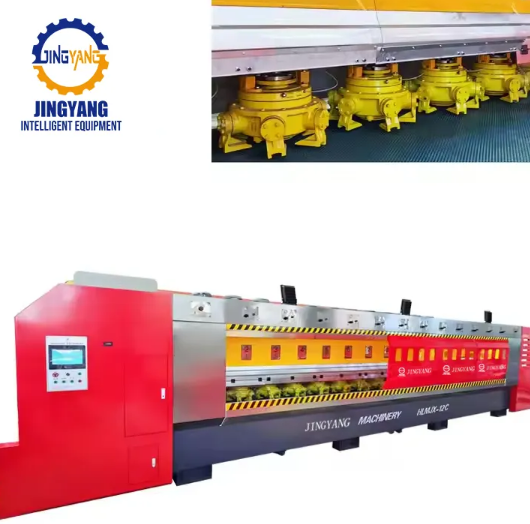
Granite’s Physical Properties and Why They Dictate Machine Selection
Granite’s exceptional hardness—typically exceeding 6 on the Mohs scale—demands diamond tooling engineered specifically for dense, silica-rich surfaces. Its high quartz content (20–45% by volume) delivers visual appeal but also increases abrasiveness, accelerating tool wear and generating significant thermal friction during cutting. With a material density averaging 165–172 lb/ft³, granite places substantial mechanical load on machinery; cutters must therefore feature robust structural rigidity to maintain positional accuracy under feed pressure and load. Ignoring these properties leads directly to blade slippage, edge chipping, and premature degradation of polishability—costly failures that cascade into extended polishing cycles, excessive tooling replacement, and material waste. These aren’t theoretical concerns: granite’s mechanical behavior dictates real-world specifications for motor torque, gantry beam stiffness, and cooling system capacity. Selecting the right granite polishing machine begins with respecting these immutable physical constraints.
Comparing Granite Cutting Machines: Bridge Saws, CNC Routers, and Gang Saws
Bridge saws: unmatched rigidity and precision for thick slab cutting
Bridge saws remain the industry standard for cutting thick granite slabs. Their fixed bridge-and-table architecture provides superior structural rigidity, enabling clean, straight cuts with minimal chipping—professional models achieve ±0.5 mm tolerance. Integrated water cooling suppresses dust, manages blade temperature, extends diamond tool life, and enhances operator safety. Large table capacity eliminates frequent repositioning of heavy slabs, reducing handling errors and boosting throughput. For fabricators prioritizing consistent edge quality in high-volume countertop production, bridge saws deliver stability and precision no other machine type matches.
CNC routers vs. gang saws: speed, versatility, and limitations for edge profiling and polishing prep
CNC routers excel in versatility—handling complex edge profiles, curves, and cutouts—but require diamond tooling and conservative feed rates to prevent chipping. Gang saws, in contrast, maximize raw slabbing speed by slicing entire granite blocks into multiple slabs in a single pass. However, they perform no edge shaping or surface preparation. A CNC router equipped with a granite polishing machine attachment bridges this gap, automating the transition from cutting to finishing—performing profiling, chamfering, and preliminary smoothing in one setup. This integration cuts rework and manual labor while improving finish consistency. When workflow demands both high-volume slabbing and refined edge quality, the choice hinges on operational priority: gang saws for throughput, CNC routers for precision and polishing readiness.
Critical Selection Criteria: Performance, Safety, and Total Cost of Ownership
Rigidity, CNC control accuracy, feed stability, and integrated cooling systems
Structural rigidity governs vibration levels—excessive vibration degrades dimensional accuracy and accelerates blade wear. Precision CNC controls ensure repeatable, tight-tolerance cuts, while stable feed mechanisms prevent micro-fractures and edge chipping. Integrated cooling systems mitigate heat buildup, preserving diamond tool integrity and surface quality. Together, these four elements define baseline performance—and directly influence operator safety: poorly stabilized or inadequately cooled machines increase risks of blade failure or workpiece ejection.
TCO drivers: blade wear, downtime, rework rates, energy use, and operator training
Total cost of ownership (TCO) far exceeds initial purchase price. Blade consumption alone often represents a major operating expense; machines with optimized rigidity and cooling reduce annual diamond tool wear by 15–20%. Unplanned downtime from mechanical failure can cost hundreds of dollars per hour in lost output. Inaccurate cuts drive up rework—wasting material, labor, and time. Energy efficiency and operator learning curve further affect long-term profitability. Strategic selection—grounded in granite’s physical realities—minimizes these hidden costs and frees capital for downstream investments, including dedicated granite polishing machine integration.
Matching the Machine to Your Production Workflow—and Preparing for Granite Polishing
Countertop shops: 5-axis CNC routers with granite polishing machine integration
Countertop shops producing custom edges, sink cutouts, and intricate profiles benefit most from 5-axis CNC routers. These systems combine high-precision routing with seamless compatibility for granite polishing machine attachments—enabling automated profiling, chamfering, and surface conditioning in a single setup. The router’s accuracy ensures uniform edge geometry, drastically reducing manual touch-ups before polishing. Integrating cutting and finishing stages minimizes material handling, lowers rework risk, and improves end-to-end throughput—making it the optimal solution for shops where design flexibility and finish consistency are non-negotiable.
Slab yards and fabricators: bridge saws with post‑cut polishing readiness and handling ergonomics
Slab yards and large-volume fabricators rely on bridge saws for efficient, repeatable sizing and straight-line cuts. Their strength lies in delivering clean, flat edges with minimal micro-chipping—ideal for immediate progression to polishing. To maximize polishing readiness, select bridge saws with high-pressure integrated coolant systems and blades designed to leave a surface free of thermal damage or subsurface fractures. Ergonomic enhancements—such as vacuum-assisted lifting, powered tilting tables, and low-friction slab supports—reduce operator fatigue and protect slab integrity, ensuring undamaged, polishing-ready material arrives at the finishing station every time.
FAQ
Why is granite's physical property important for machine selection?
Granite has unique properties such as exceptional hardness, high density, and a high quartz content. These attributes make it abrasive, increase tool wear, and demand specific machinery with proper rigidity, cooling, and cutting capabilities to achieve high precision without material damage.
What are the key differences between bridge saws, CNC routers, and gang saws?
Bridge saws are ideal for straight, precise cuts and thick slabs, while CNC routers handle intricate profiles and shapes with versatility. Gang saws excel at high-volume slabbing but lack edge finishing capabilities. Each serves different purposes based on desired workflow outcomes.
What factors should I prioritize when selecting granite-cutting machinery?
Key factors include structural rigidity, CNC control precision, stable feed mechanisms, and integrated cooling systems. These elements ensure accuracy, prolong tool life, and reduce heat-induced imperfections, significantly impacting performance and safety.
How can I reduce the total cost of ownership (TCO) for granite machinery?
Choose machines with optimized rigidity and integrated cooling systems to lower blade wear. Focus on energy efficiency, minimal rework rates, and reduced downtime to cut hidden costs while investing in operator training for efficient machine operation.
Which machine is best for countertop shops?
5-axis CNC routers with granite polishing machine integration are ideal for countertop shops. They allow automated profiling, chamfering, and precision, improving throughput while minimizing material handling and rework.
Why are ergonomic enhancements important for slab yards?
Ergonomic features like vacuum-assisted lifting and tilting tables reduce operator fatigue, minimize handling errors, and prevent slab damage, ensuring that material reaches the polishing stage in optimal condition.
Table of Contents
- Granite’s Physical Properties and Why They Dictate Machine Selection
- Comparing Granite Cutting Machines: Bridge Saws, CNC Routers, and Gang Saws
- Critical Selection Criteria: Performance, Safety, and Total Cost of Ownership
- Matching the Machine to Your Production Workflow—and Preparing for Granite Polishing
-
FAQ
- Why is granite's physical property important for machine selection?
- What are the key differences between bridge saws, CNC routers, and gang saws?
- What factors should I prioritize when selecting granite-cutting machinery?
- How can I reduce the total cost of ownership (TCO) for granite machinery?
- Which machine is best for countertop shops?
- Why are ergonomic enhancements important for slab yards?