
 EN
EN



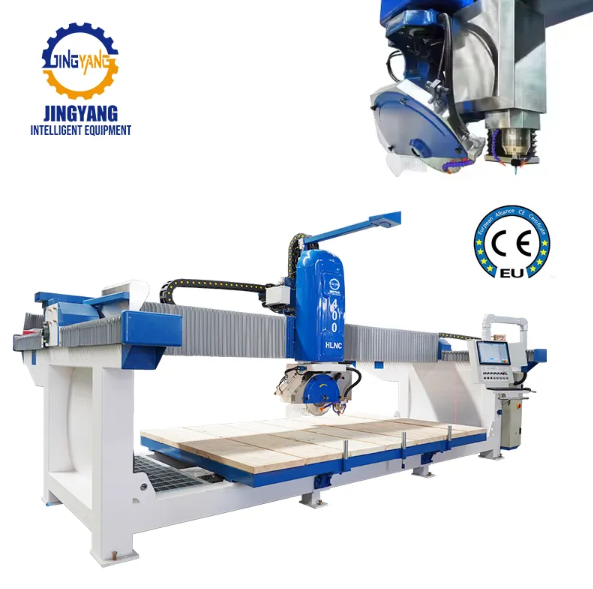
Automation Accelerates Cycle Time and Reduces Labor Dependency
Automatic tool changing and slab positioning cut average cycle time by up to 35%
Automatic tool changers swap diamond blades in seconds—eliminating manual interventions that previously cost minutes per change. Slab positioning systems use laser or camera sensors to align stone precisely on the cutting bed, removing the need for re-adjustment. Together, these features reduce average cycle time by up to 35% compared to manual operation. For fabricators evaluating a granite bridge saw for sale, models with integrated automation process more slabs per shift while enabling operators to oversee multiple machines. Labor dependency drops significantly: fewer workers are needed for tool swaps and alignment checks.
PLC-integrated control enables real-time optimization and rapid fault recovery
A programmable logic controller (PLC) continuously monitors spindle load, blade wear, and coolant flow during each cut. When parameters drift from optimal ranges, the system instantly adjusts feed rates to preserve both quality and speed. If a fault occurs—such as a blade jam or coolant interruption—the PLC triggers automated diagnostics and can restart the machine after clearing the issue. This real-time responsiveness prevents wasted cycle time and reduces unplanned downtime. Shops using PLC-integrated bridge saws sustain higher throughput and require less skilled labor for troubleshooting.
Precision Cutting Speeds Up Complex Stone Fabrication
Modern bridge saws dramatically accelerate intricate stone projects—not through brute force, but through precision cutting that delivers exponential time savings over traditional methods. Consider templated entryways or architectural collages: historically, these required repeated repositioning and tool changes per tile. 5-axis granite bridge saw for sale models eliminate over 70% of manual repositioning steps by enabling simultaneous rotation and tilting of the cutting head—producing complex miters, drains, and undercuts within a single clamping cycle. Setup time drops by approximately 40%, based on industry workflow benchmarks. Multi-axis capability transforms chases into clean channels and awkward angles into precise flush joins—tasks once requiring multiple passes. By consolidating processes into one operation or executing full-edge trimming in a single start-to-finish pass, even the most demanding stone projects scale predictably: output shifts from “days per piece” to “sheets per day.” Angular variations no longer trigger full pauses, and deeper contours maintain positional exactness. The result is machine-consistent execution, fewer fitting errors, higher material utilization, faster time-to-install, and increased production volume—turning complexity into routine without compromising fitment.
Smart Nesting and CAM Integration Maximize Material Yield and Throughput
Advanced nesting algorithms boost marble and granite yield by 12–18%, lowering cost-per-foot
Modern CAM software paired with a granite bridge saw for sale improves material utilization through intelligent nesting algorithms. These analyze slab dimensions, part geometry, and cutting constraints—including blade kerf, grain direction, and remnant viability—to generate layouts that minimize waste. Compared to manual layout methods, this boosts marble and granite yield by 12–18%. The gain directly lowers cost-per-foot by extracting more finished product from each raw slab and reducing discarded partials. Integrated CAD-to-CAM workflows further streamline production, eliminating manual programming steps and minimizing human error.
CNC Bridge Saw Productivity vs. Manual Operation: Measurable Gains
Automated CNC bridge saws transform granite fabrication by delivering substantial, quantifiable productivity gains over manual methods. They operate continuously without breaks and achieve cutting speeds up to 300% faster than manual saws for repetitive tasks. One operator can efficiently manage multiple machines—increasing throughput while reducing labor costs by 20–25% per square foot. In demanding stone environments, this delivers three core efficiency advantages:
- Speed & Consistency: Automated execution removes human variability, ensuring identical precision across all cuts and reducing processing time per slab
- Labor Optimization: Automation supports scalable 24/7 production with fewer operators
- Error Reduction: Pre-programmed digital controls lower defect rates by 18–22%, minimizing material waste and costly rework
Beyond output metrics, CNC bridge saws enhance workplace safety by limiting direct blade interaction. Facilities upgrading to automated cutting solutions typically recover equipment investment within 14–18 months through sustained productivity gains and reduced operational expenses.
FAQs
What is the main benefit of automation in granite bridge saws?
Automation dramatically reduces cycle times by up to 35% and lowers labor dependency, enabling fabricators to process more slabs per shift while requiring fewer operators.
What is a PLC and how does it enhance bridge saw operations?
A Programmable Logic Controller (PLC) monitors and adjusts essential parameters, such as spindle load and coolant flow, in real-time. It improves cutting efficiency, reduces downtime, and provides rapid fault recovery.
How do 5-axis bridge saws improve cutting precision?
5-axis bridge saws enable simultaneous rotation and tilting of the cutting head, eliminating over 70% of manual repositioning and simplifying complex cuts like miters, drains, and undercuts in a single cycle.
What are the advantages of smart nesting and CAM integration?
Smart nesting increases material yield by 12–18%, reduces waste, and lowers the cost per foot, while CAM integration improves production efficiency by automating layout and programming processes.
How does a CNC bridge saw compare to manual cutting?
CNC bridge saws provide faster, more consistent cutting, reduce labor costs by 20–25%, and lower defect rates by 18–22% compared to manual cutting methods.
How quickly can facilities recover their investment in CNC bridge saws?
Facilities typically recover their investment in automated cutting equipment within 14–18 months through increased productivity and reduced operational costs.
Table of Contents
- Automation Accelerates Cycle Time and Reduces Labor Dependency
- Precision Cutting Speeds Up Complex Stone Fabrication
- Smart Nesting and CAM Integration Maximize Material Yield and Throughput
- CNC Bridge Saw Productivity vs. Manual Operation: Measurable Gains
-
FAQs
- What is the main benefit of automation in granite bridge saws?
- What is a PLC and how does it enhance bridge saw operations?
- How do 5-axis bridge saws improve cutting precision?
- What are the advantages of smart nesting and CAM integration?
- How does a CNC bridge saw compare to manual cutting?
- How quickly can facilities recover their investment in CNC bridge saws?