
 EN
EN



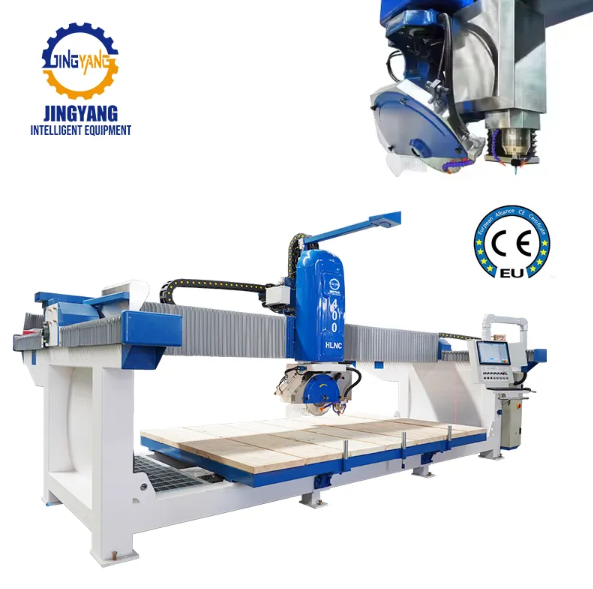
Unmatched Precision and Dimensional Accuracy
Sub-millimeter tolerances on granite and marble: How bridge architecture ensures rigidity and repeatability
Hand tools rely entirely on operator steadiness—introducing variability that compounds across repeated cuts. A stone bridge saw eliminates this human factor through its rigid gantry structure: the bridge supports the cutting head on two parallel beams, creating a fixed, non-deflecting path even under heavy loads. This design enables fabricators to hold tolerances within 0.5 mm on dense materials like granite and marble.
Repeatability stems from precision linear guides and high-grade bearings that return the blade to the exact same position for every pass. Operators set the digital readout once and trust the machine to replicate identical cuts across dozens of slabs—eliminating manual re-measurement and marking. The result is edge consistency that requires minimal post-polishing and fits seamlessly against adjacent tiles or countertops without gaps. This level of accuracy directly reduces material waste and rework, transforming high-cost natural stone into a predictable, profitable product.
Real-world impact: Fabricator cuts fit-up errors by 92% after switching to a bridge tile saw
The operational gap between manual techniques and a bridge tile saw becomes unmistakable in real-world performance. One mid-sized stone workshop tracked fit-up defects before and after installation: with handheld grinders and manual tile cutters, roughly 12% of finished pieces required on-site adjustments due to mismatched edges or inconsistent depth. After adopting a bridge saw, that rate dropped to under 1%—a 92% reduction in fit-up errors.
This improvement came from the saw’s ability to maintain true 90° angles and a consistent blade path across the full slab length. Practically, it eliminated time spent shimming, recutting, and troubleshooting misaligned joints—freeing skilled workers for complex mitering and decorative profiling. Inventory waste also declined: less stone was scrapped, and leftover remnants became viable stock. For shops balancing quality, cost, and throughput, the switch delivers an immediate, measurable ROI.
Significant Gains in Speed and Workflow Efficiency
Throughput comparison: 120 sq. ft./hr with a bridge tile saw vs. 15 sq. ft./hr manually
Independent bench studies confirm dramatic throughput gains when upgrading to bridge tile saw technology. The rigid overhead architecture sustains cutting speeds of 120 sq. ft./hr, compared to just 15 sq. ft./hr achievable manually. Precision-guided rails prevent layout drift, while optimized blade geometry minimizes binding in dense quartzites. Engineered features—including laser alignment systems and pulsing feed drives—maintain kerf accuracy at peak velocities. Frontline shop data shows integrated workflows enable comparable labor shifts to process up to eight times more material.
| Stone Type | Manual Cutting Rate (sq. ft./hr) | Bridge Saw Rate (sq. ft./hr) | Improvement Factor |
|---|---|---|---|
| Granite | 14 | 105 | 7.5x |
| Marble | 18 | 130 | 7.2x |
| Quartzite | 12 | 95 | 7.9x |
Seamless integration: From slab unloading to templated cutout in a single, optimized station
Modern fabrication workflows consolidate value-adding steps into unified stations. Slabs unload directly onto adjustable bridge saw rails, where preset CNC programs execute templated cutouts—eliminating manual measurement entirely. GPS-guided templating robots sync with bridge saws to trigger contouring immediately after squaring, creating a fully sequenced “cut-to-polish” workflow.
By removing transport delays between operations, integrated setups reclaim transit time for productive cutting. Lean methodology audits identify inter-operation delays as contributing to 32% of total cycle time waste—a loss fully recoverable through such seamless integration.
Enhanced Safety, Ergonomics, and Regulatory Compliance
Wet-cutting + integrated dust extraction: 95% reduction in respirable crystalline silica (OSHA-aligned)
Bridge saws suppress dust at the source via built-in water delivery—unlike dry-angle grinders, which aerosolize hazardous respirable crystalline silica (RCS). Wet cutting captures over 95% of airborne particles, aligning with OSHA’s permissible exposure limit (PEL) of 50 µg/m³ averaged over an 8-hour shift. Integrated slurry extraction ports further remove contaminated water from the operator zone, reducing reliance on respirators and minimizing cleanup. Facilities using this approach not only meet regulatory standards but also mitigate long-term occupational lung disease risk—and avoid costly OSHA citations and insurance premium increases tied to silica exposure incidents.
Operator ergonomics: Eliminating repetitive strain from handheld grinders and manual layout
Handheld tools force operators into sustained awkward postures—kneeling, bracing, and twisting—leading to chronic wrist, shoulder, and back fatigue. A bridge tile saw automates the cutting stroke and digital positioning, allowing operators to control cuts from a standing, neutral posture. No grinding, no layout recalibration, no physical pushing or pulling.
This ergonomic shift reduces repetitive motion injuries, improves daily output, and lowers workers’ compensation claims. Shops report fewer sick days and higher job satisfaction—while eliminating manual layout errors also cuts handling-related waste and breakage.
Clear Economic Thresholds for Adopting a Bridge Tile Saw
The economic case for a bridge tile saw solidifies at specific production volumes. Fabricators typically achieve meaningful ROI when processing more than 1,500 square feet of countertop material per month. Below that threshold, manual or semi-automated solutions may remain cost-effective—but above it, payback periods consistently fall within 6–18 months, driven by reduced labor, lower material waste, and decreased breakage.
High-volume operations realize compound benefits: accelerated workflow, tighter tolerances, and improved labor utilization all contribute to tangible, bottom-line savings—fully offsetting the initial investment.
FAQ
What is the primary advantage of a bridge tile saw over manual tools?
A bridge tile saw provides unmatched precision, repeatability, and dimensional accuracy while reducing material waste and enhancing efficiency. It eliminates human error by using a rigid gantry structure and precision-guided systems.
How does a bridge tile saw improve production speed?
A bridge tile saw can process up to 120 sq. ft. per hour compared to only 15 sq. ft. per hour with manual tools. This enables shops to achieve up to eight times more throughput.
Is using a bridge tile saw safer than manual tools?
Yes, bridge tile saws enhance safety with wet-cutting systems and integrated dust extraction, capturing over 95% of respirable crystalline silica, complying with OSHA safety standards.
When does it make financial sense to invest in a bridge tile saw?
A bridge tile saw is cost-effective when processing more than 1,500 square feet of material per month, achieving an ROI in 6–18 months based on reduced labor costs and material savings.
What ergonomic benefits do bridge tile saws offer?
Bridge tile saws reduce physical strain on operators by automating cuts, allowing standing neutral postures, and eliminating the need for manual grinding or layout recalibration.