
 EN
EN


Hard Rock Is Not Just Stronger Stone
Hard rock extraction starts with a simple fact. The rock does not care about a machine's marketing sheet. Granite, basalt, quartzite, and some dense limestones can reach uniaxial compressive strength of 150 MPa to 300 MPa. That strength changes almost every decision, from hole spacing to cutting speed to bench design. A stone quarry machine that performs well in soft marble may struggle in tight-grained granite. Hardness is only one variable. Abrasiveness, fracture density, joint orientation, and silica content all shape tool wear and machine stability. In a deposit with widely spaced joints, a hydraulic breaker may open the face quickly. In a massive, unfractured zone, the same breaker can hammer with poor results. Hard rock extraction usually rewards a mix of drilling, controlled splitting, and sawing rather than one brute-force tool.
Drilling Rigs That Open the Face Without Wasting the Deposit
For hard rock, drilling sets the tone. Top hammer rigs are common on smaller benches and tighter patterns, often with hole diameters from 64 mm to 102 mm. Down-the-hole hammers shine when the rock is very hard and the bench is deep. The hammer strikes directly at the bit, so less energy is lost through the drill string. A DTH rig can hold productive rates in basalt and quartzite where a top hammer may need more frequent bit changes. The trade-off is air demand, dust control, and cost per meter. In a 12 m granite bench, a quarry might use 76 mm to 89 mm holes on a 2.5 m to 3.0 m grid for splitting. The wrong pattern creates overbreak or a face that will not move. A stone quarry machine selected for drilling should match the rock's strength, abrasiveness, and joint spacing, not just the advertised hole size.
Wire Saws, Chain Saws, and Splitters in Hard Rock
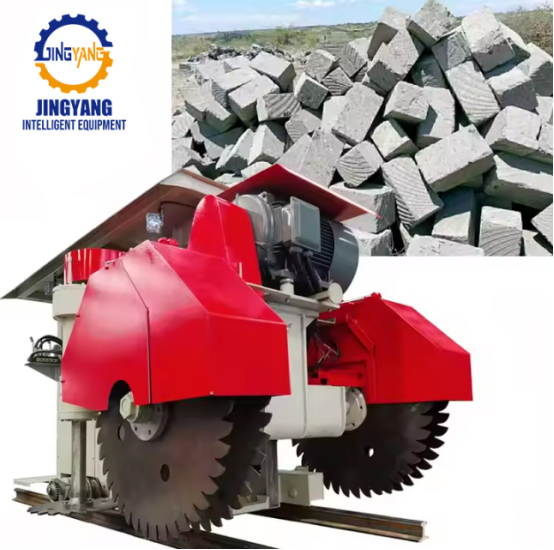
Diamond wire saws are often the most precise option for hard rock block extraction. A stone quarry machine running a wire saw can cut granite and basalt with good control, especially when pilot holes are drilled accurately. The limitation is setup time. A wire saw needs a clear path, water, and a face that allows the wire to travel without twisting. Chain saws cut softer to medium-hard stone efficiently, but in very hard, abrasive rock the chain wear and cutting forces rise quickly. Hydraulic splitters work between drilled holes and can produce clean breaks when the hole line follows the natural plane. They are not a high-volume primary extraction tool, yet they are excellent for secondary breaking and dimensional work. A practical hard rock lineup often includes a DTH drill, a diamond wire saw, and a hydraulic splitter. That combination covers pilot holes, primary cuts, and oversize reduction.
A Comparison Table for Hard Rock Machine Selection
Machine type |
Typical rock strength |
Best use |
Main limitation |
Top hammer drill rig |
80 to 200 MPa UCS |
Small to medium benches, pattern drilling |
Bit wear in abrasive quartzite |
DTH drill rig |
120 to 300 MPa UCS |
Deep benches, very hard rock |
High air demand, dust control |
Diamond wire saw |
100 to 300 MPa UCS |
Dimensional block cutting |
Setup time, water supply |
Hydraulic splitter |
80 to 250 MPa UCS |
Secondary breaking, controlled splitting |
Low primary output |
Chain saw |
40 to 120 MPa UCS |
Medium-hard stone, block shaping |
Rapid wear in high silica rock |
What Quarry Conditions Really Decide the Winner
Machine type is only half the story. Bench geometry, water access, transport roads, and downstream processing matter just as much. A diamond wire saw may be ideal in a granite quarry with a clean, vertical face, but it becomes awkward if the bench is broken and the face lacks a stable line. A DTH rig may drill fast, yet the quarry still needs a way to move large blocks without cracking them. Joint orientation is another factor. When the dominant joint set runs parallel to the intended cut, splitting and sawing become easier. When joints run across the block, the risk of uncontrolled breaks rises. In hot, dusty regions, cooling and filtration for hydraulic systems become a daily concern. The right stone quarry machine is the one that fits the deposit, the product mix, and the crew's maintenance skills.
A Field Example and a Practical Fleet Strategy
A granite quarry in southern China offers a useful case. The face had a UCS around 180 MPa and tight joints. The original plan used a hydraulic breaker as the main extraction tool. Production was inconsistent, and many blocks fractured along unwanted planes. After a trial, the crew switched to 89 mm DTH holes, a diamond wire saw for primary cuts, and hydraulic splitters for oversize. The breaker stayed on site, but its role shifted to secondary breaking. Block yield improved because the wire saw followed the planned plane, and the splitter opened the rock with less shock. The change did not remove every problem. Wire setup took time, and the crew had to improve hole accuracy. Still, the mixed method matched the rock better than a single-machine approach. Industry standards such as the ISRM suggested methods for rock characterization help teams compare strength and structure in a consistent way. Jingyang, a stone quarry machine manufacturer, supports buyers with manufacturing capability, quality control, and supply chain coordination. A site-specific trial should guide the final purchase, not a catalog alone.