
 EN
EN



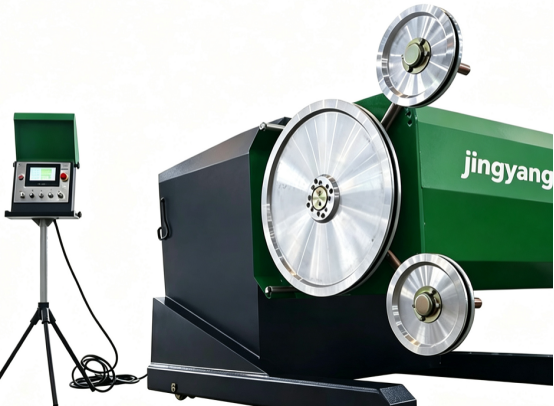
Why Waste Control Starts Before the First Cut
Quarry managers often track tonnage first. In dimension stone, the real money sits in the block that stays intact. A block split by explosive shock may look solid outside, but internal microfractures can turn a high value cube into cracked slabs. That is where a diamond wire machine changes the conversation. Instead of breaking rock with a sudden release of energy, the machine cuts a narrow path and leaves the surrounding mass largely undisturbed. Less overbreak means fewer wasted fragments, fewer downstream repairs, and more usable volume from each bench. The benefit is not just speed. It is geometry control.
How a Diamond Wire Machine Cuts Rock With Controlled Abrasion
A diamond wire machine uses a closed loop of steel cable fitted with diamond impregnated beads. The wire runs through guide pulleys, enters the rock at a planned angle, and grinds a kerf as it travels. Water flushes the cut, cools the beads, and carries away fines. The cutting action is abrasive, not percussive. Diamond grit scratches and fractures mineral grains at a small scale. Rock removal happens gradually along the wire path.
Several variables decide whether the cut stays clean:
- Wire tension, which affects straightness and bead life.
2.Feed speed, which must match rock hardness and wire speed.
3.Water flow, which controls heat and slurry removal.
4.Pulley alignment, which prevents side load and wire wander.
In hard granite, a wire speed that is too low can polish the beads instead of cutting. In softer marble or limestone, excessive tension can oval the hole or damage block edges. Setup is where waste is won or lost.
Setup Decisions That Protect Block Value
The first cut sets the tone. If guide holes are drilled out of line, the wire will fight the rock and the cut face will drift. A deviation of a few millimeters may not matter for aggregate, but it can ruin a dimension stone block. Quarry teams usually drill vertical and horizontal holes with a slight intersection tolerance. Then the wire is threaded, tensioned, and brought up to speed before the feed engages.
Cooling water matters more than many new operators expect. Low flow leads to bead glazing and a slurry that packs into the kerf. That packed slurry increases friction and can cause wire wander. Clean water and a steady return flow keep the cut predictable. At a granite quarry in southern China, a crew tried a faster feed. The wire deflected, and the block face showed a wave. After reducing feed and increasing water flow, the cut came back straight.
A Field Case From a Southern China Quarry
At a granite quarry in southern China, the crew was extracting large blocks from a bench with limited space. Drilling and blasting had been the default method, but the operation wanted fewer cracks and better block recovery. A diamond wire machine was brought in for a trial cut on a 12 m by 6 m by 5 m block. The first attempt used too much tension and a fast feed. The wire drifted, and the cut face showed slight deviation. After lowering tension, increasing water flow, and aligning the guide pulleys within 2 mm, the next block came out with a flat face and fewer visible cracks. The quarry reported roughly 18 percent more usable block volume from the same bench area. The result was not universal, because rock structure and operator skill vary.
Comparing Methods With Realistic Numbers
Different extraction methods create different waste profiles. The table below summarizes typical ranges reported by quarry teams and equipment suppliers. Actual results depend on rock type, joint spacing, and crew experience.
Method |
Typical block yield |
Kerf or fracture loss |
Vibration |
Best fit |
Diamond wire cutting |
70 to 85 percent |
8 to 11 mm kerf |
Low |
Hard to medium rock, dimensional blocks |
Drilling and blasting |
40 to 60 percent |
High from overbreak and cracks |
High |
Bulk removal, less regular blocks |
Expansive grout |
55 to 70 percent |
Low kerf, slow splitting |
Low |
Sound rock, small to medium blocks |
Chain saw cutting |
60 to 75 percent |
20 to 40 mm kerf |
Low to moderate |
Softer stone, shallow cuts |
The table is not a scorecard. Waste comes from several places. A wide kerf wastes rock as powder. Blasting wastes rock through cracks. Slow methods waste time and labor. The diamond wire machine sits in a useful middle ground when block value is high and downstream processing costs matter.
Limits, Tradeoffs, and Equipment Support
A diamond wire machine is not a universal answer. It needs water, power, and a reasonably stable bench. Very fractured rock can pinch the wire. Extremely hard rock can wear beads quickly. Operator skill matters, and a poorly trained crew can destroy a good block with bad tension or feed settings. Guide holes must be accurate, and the cut sequence must respect natural joints. In some quarries, drilling and blasting still makes sense for opening a face or removing overburden.
Industry standards and certification frameworks point in the same direction. Equipment makers that follow ISO 9001 and ISO 14001 practices tend to pay closer attention to process control, environmental management, and safety. China's National Mining Machinery Standardization Committee has also worked on standards for stone mining equipment, including circular saw machines, which shows a broader push toward controlled extraction. For buyers, the practical question is not just machine price. It is whether the supplier understands quarry conditions, can support setup, and can keep parts and service available.
Jingyang has built its reputation around stone mining and processing equipment, with manufacturing capacity, quality control systems, and supply chain support for quarry operations.