
 EN
EN



Start With the Material Mix, Not the Spec Sheet
A mixed stone fabrication shop rarely gets to choose one stone. Monday might bring a Calacatta marble vanity, Wednesday a black granite countertop, and Friday a limestone fireplace surround. That variety is why the search for a marble and granite cutting machine can go sideways fast. A machine that looks strong on a granite-only job may chip marble, struggle with delicate veining, or force slow hand finishing. The first question is not "what saw is fastest?" It is "what range of cuts, thicknesses, and finishes must leave the shop without rework?" The job mix from the past six months, including slab sizes, edge profiles, and sink cutouts, becomes the filter for every quote.
Blade, Feed, and Water Decide the Cut Quality
Marble and granite behave like distant cousins. Granite is abrasive and hard, so diamond bond hardness, segment concentration, and feed rate matter. Marble is softer but often more brittle, so vibration control, blade tension, and coolant volume can make the difference between a clean edge and a spiderweb of chips. Running one blade and one feed setting for everything is a common mistake. A softer bond may suit hard granite, while a finer, tighter blade often helps marble. Coolant flushes abrasive slurry, reduces dust, and stabilizes the cut. OSHA's respirable crystalline silica standard for general industry and maritime work (29 CFR 1910.1053) pushed many shops to integrate water-fed cutting and dust controls, and that shift changed how equipment is specified. If a supplier cannot explain the blade and coolant plan for both stone types, the quote is incomplete.
Bridge Saw, CNC, or Waterjet? Compare the Real Tradeoffs
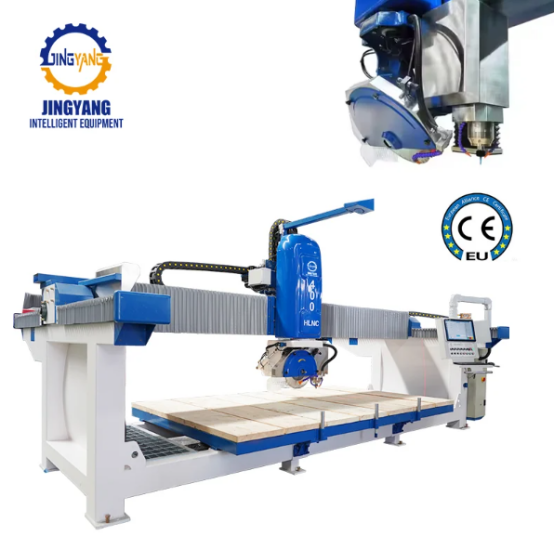
No single machine wins every mixed-shop task. A bridge saw often handles straight cuts and large slabs with predictable cost. A CNC stone center adds contouring, sink cutouts, and repeatable shapes. A waterjet cuts intricate inlays and heat-sensitive material but has higher operating cost and slower thick-stone performance. Typical planning ranges are shown below, not guaranteed production numbers.
Capability |
Bridge Saw |
CNC Stone Center |
Waterjet |
Best fit |
Straight slab cuts, miters |
Cutouts, curves, profiling |
Intricate inlays, mixed material |
Typical capital cost |
Lower |
Medium to high |
High |
Thickness comfort |
Medium to thick |
Medium |
Thin to medium |
Edge finish after cut |
Good with right blade |
Good, often less hand work |
Very fine, minimal chipping |
Floor space |
Moderate |
Moderate to high |
Moderate to high |
Main operating cost |
Blades, water, power |
Tooling, water, power |
Abrasive, water, power |
Limitation |
Curves need secondary work |
Setup time for one-offs |
Slow on thick granite |
The right answer may be a bridge saw plus a CNC, or a waterjet paired with a robust saw. The mix of jobs decides the combination.
Check the Building Before the Machine Arrives
A machine that fits the work but not the building is an expensive mistake. Measure door widths, ceiling height, floor load capacity, and the turning radius for a forklift or crane. Check available voltage, phase, and breaker capacity. Water supply, drainage, and slurry separation often get ignored until installation week. A shop cutting granite daily can produce fine abrasive waste that clogs drains and settles in tanks. In one southern China fabrication shop, a new bridge saw was specified for granite production, but the slab storage aisle was too narrow for the trolley. The machine sat idle for two weeks while the layout was rebuilt. The cutting performance was fine. The workflow was not.
Ask for Test Cuts on the Actual Stone Mix
Brochure horsepower and spindle speed do not reveal how a machine handles a 20 mm marble slab with heavy veining or a 30 mm black granite top. Ask for a test cut using samples from the shop's own inventory. Watch for chipping at the exit edge, blade wander, burn marks, and water coverage. Measure the squareness of a large cut and the consistency of repeat cuts. If a CNC or waterjet is part of the plan, test a sink cutout and a curved profile. A test cut also shows how quickly the software and operator can move from drawing to first part, which matters in a mixed shop. ASTM C503 and ASTM C615 describe dimension stone categories, and they are useful for talking about material expectations, but the final proof is the edge coming off the machine.
Fit the Machine to the Shop's Growth Plan
A mixed stone fabrication shop changes. Maybe countertops grow, maybe architectural work expands, maybe the shop adds a second shift. The equipment plan should leave room for that change without buying capacity that never gets used. Look at service access, spare parts availability, and training support. A supplier with stone industry experience can often spot layout and tooling problems before they become downtime. Jingyang brings quarry and stone processing machinery experience to these decisions, along with quality management and environmental system certifications. Its background in complete equipment sets and industry standards work gives mixed shops a practical partner for planning saws, CNC centers, and support equipment as one system.