
 EN
EN


What a Five Axis Machine Actually Adds to the Cutting Process
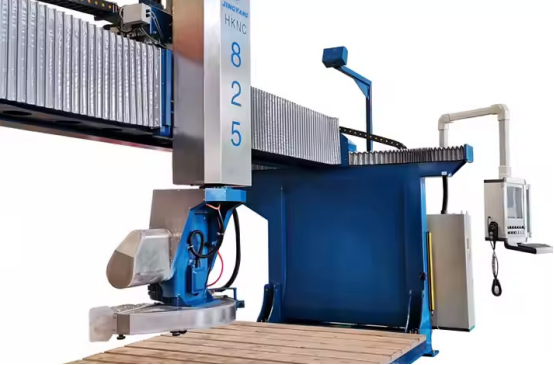
A standard bridge saw moves in three axes. The blade travels along the beam, the beam moves across the table, and the head moves up and down. That setup handles straight cuts, square edges, and basic miter work without much trouble. A five axis bridge saw adds two more degrees of motion. The head can tilt, and the table or head can rotate. Those extra movements change what the machine can do on a single setup.
In stone fabrication, the practical benefit shows up quickly. A five axis CNC granite saw can cut an angled edge, follow a curved profile, or prepare a miter joint without forcing the operator to reposition the slab several times. That reduces handling time and keeps cuts aligned to the same reference point. For countertop shops, the difference often appears in the fit between an angled island corner and a straight run. A three axis machine cuts the parts separately. A five axis machine cuts them in sequence, using the same zero point.
Where the Real Productivity Gain Comes From
Productivity in a stone shop isn't only about blade speed. A faster saw that needs more manual setups can easily finish the day behind a slower machine that holds position through multiple operations. Five axis equipment shifts the balance toward fewer setups and fewer manual adjustments.
A good way to picture the difference is to think about a typical mitered waterfall edge. The fabricator needs a 45 degree cut on the horizontal deck and a matching 45 on the vertical panel. On a three axis saw, the operator sets an angle fixture, cuts the deck, resets for the panel, checks the angle, and cuts again. On a five axis machine, the head tilts to the required angle, the control holds the position, and both pieces come off with the same reference. The time saved per piece may look small, but over a full week of kitchen jobs, it adds up.
The table below compares typical setup behavior for common stone cutting tasks.
Cutting Task |
Three Axis Bridge Saw |
Five Axis Bridge Saw |
Straight rectangular cuts |
Simple setup |
Simple setup |
Standard 45 degree miter |
Manual angle fixture |
Programmed head tilt |
Curved sink cutout |
Not practical |
Programmed path |
Compound angle cuts |
Multiple repositioning |
Single positioning |
Repeated angled pieces |
Reset for each part |
Repeat from same reference |
Why the Control System Matters More Than People Expect
The mechanical structure of a five axis saw matters, but the control system often decides whether the machine is easy to use or a daily headache. Older CNC controls required the operator to understand G-code or work through complicated menus. Newer systems use touchscreen interfaces, graphical previews, and stored cutting programs.
This is where the choice of control platform becomes a practical buying question. Some five axis bridge saws, including several Jingyang models, run on an ESA CNC system paired with Pegasus CAD/CAM software. That combination matters because it connects the cutting path directly to the machine's tilting and rotary axes. Instead of exporting a file, converting it, and hoping the angles survive the transfer, the operator can work inside one software environment. The control reads the geometry, the saw positions the blade, and the program runs without a separate translation step.
That kind of integration is especially useful in shops where the person running the saw is also templating jobs and managing slabs. A control system that reduces angle changes to a few screen taps keeps the machine busy. A system that demands constant manual entry tends to push shops back toward using the machine like a standard three axis bridge saw.
Tooling and Programming Still Decide Edge Quality
Five axis motion doesn't automatically produce clean edges. Blade condition, feed rate, and spindle speed still control the final result. In fact, angled cuts are less forgiving than straight cuts because the blade contact area changes along the angle. If the feed rate is too aggressive, chipping appears on the top edge of granite or engineered stone.
A practical rule in many shops is to slow the feed rate by roughly 15 to 25 percent on miter cuts compared to straight cuts, then adjust based on the material. Dense quartzite usually needs a lower feed rate than standard granite. The saw manufacturer can provide a starting range, but the final setting comes from test cuts on the same slab batch.
Programming also matters more than the machine type. A poorly generated toolpath will force the blade into tight transitions, create dwell marks, or overcut at the end of a pass. This is another reason why integrated CAD/CAM software makes a difference. When the program and the machine control share the same coordinate system, there's less room for post-processing errors. The operator still needs to verify the first piece from each program before running a full batch, but the starting point is cleaner.
When a Five Axis Machine Makes Sense and When It Doesn't
A five axis bridge saw isn't automatically the right choice for every shop. For a facility that cuts mostly rectangular pieces, straight kitchen runs, and simple backsplashes, a high quality three axis bridge saw may be the better financial decision. The extra investment only pays back when angled work, curved cutouts, or complex edge profiles appear regularly.
Shops that serve custom home builders, commercial interiors, or high end retail spaces tend to see more of that type of work. Vanity tops with angled corners, reception desks with curved fronts, and stair treads with mitered returns all benefit from five axis capability. A shop doing mostly rental apartment counters may never need the extra motion.
There's also a learning curve. The machine is more complex, and the operator needs time to understand how to set angles safely. Slab placement becomes more important because the tilting head changes clearance. A setup that works for straight cuts may not have enough room for a tilted blade near the edge of the table. Those details are manageable, but they require attention. A control system with a clear graphical interface shortens that learning period, especially when the software shows the blade position before the cut starts.
Why Machine Build Quality Still Outweighs the Axis Count
One mistake buyers sometimes make is focusing too much on the number of axes and too little on the frame, guides, and spindle. A five axis machine built on a light frame will lose accuracy quickly. The angled cuts add lateral forces that a three axis machine doesn't see. The beam, column, and rotary components all need enough mass and stiffness to hold position under those loads.
That's where a manufacturer with long experience in stone equipment makes a practical difference. Jingyang has spent years developing stone cutting machinery and understands how fabrication shops actually work. That background shows in the way structural components are designed, how guides are protected, and how the ESA CNC platform is matched with Pegasus software for real production needs. A well-engineered five axis bridge saw becomes a flexible tool for daily work. A poorly built one becomes an expensive straight cut machine. The axis count gets attention, but the engineering and control integration underneath it determine whether the machine earns its place on the shop floor.
Table of Contents
- What a Five Axis Machine Actually Adds to the Cutting Process
- Where the Real Productivity Gain Comes From
- Why the Control System Matters More Than People Expect
- Tooling and Programming Still Decide Edge Quality
- When a Five Axis Machine Makes Sense and When It Doesn't
- Why Machine Build Quality Still Outweighs the Axis Count