
 EN
EN



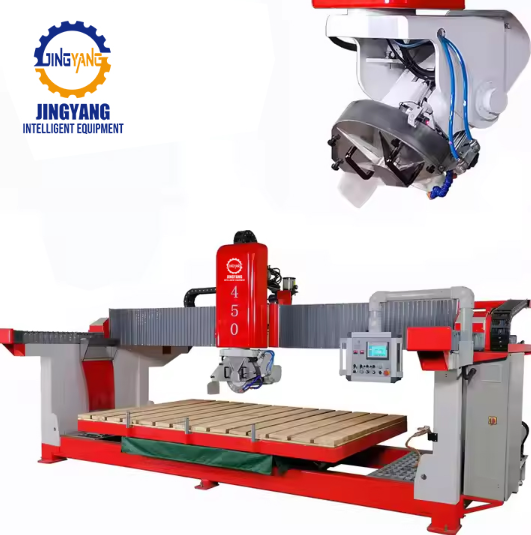
What a Bridge Saw Actually Does in a Modern Stone Shop
A bridge saw for stone remains one of the most direct answers to a basic fabrication problem: turning a rough slab into straight, repeatable cuts without fighting the material. The machine gets its name from the overhead beam that spans the cutting table. A motorized head travels along that beam, carrying a diamond blade down through granite, quartzite, or engineered stone. Water runs continuously to cool the blade and keep silica dust out of the air.
Shops that cut kitchen countertops, vanity tops, stair treads, and commercial cladding still lean on this tool daily. The reason is simple. Most rectangular cuts do not need five axis motion. They need a stable table, a blade that stays square, and enough repeatability to cut the same dimension fifty times without drifting.
The modern version has evolved well beyond the manual machines of the 1990s. Laser guides, digital readouts, programmable stops, and tilting heads have turned what was once a heavy workshop tool into a fairly precise production machine. The core job has not changed, but the consistency has improved a lot.
Where a Bridge Saw Still Beats Newer Alternatives
CNC saws and waterjet machines get a lot of attention, and for good reason. They can shape complex profiles, cut sink openings, and handle curved work that a bridge saw cannot. But on straight-line cutting and basic rectangular production, a bridge saw still holds several practical advantages.
For one thing, the cutting speed on long straight passes is generally higher. A large diameter blade can move through a three centimeter granite slab faster than a waterjet nozzle. That matters when a shop runs twenty or thirty slabs per week.
The operating cost tells a similar story. Waterjet systems consume abrasive garnet, high pressure pumps, and more maintenance hours. A bridge saw needs diamond blades, water, and basic electrical power. Blade wear is real, but the overall operating burden for straight cutting is usually lower on a bridge saw.
The table below compares typical straight cutting characteristics across three common machine types for granite slab processing. The cost levels reflect average shop conditions, not laboratory settings or universal pricing.
Machine Type |
Straight Cutting Cost Level |
Typical Accuracy for Straight Cuts |
Main Consumable |
Bridge Saw |
Low |
±0.5 mm |
Diamond blade |
CNC Saw |
Medium |
±0.3 mm |
Blade and tooling |
Waterjet |
High |
±0.2 mm |
Garnet abrasive |
Actual operating cost varies with local electricity rates, labor, slab thickness, and machine configuration. The table is meant to show relative cost relationships, not fixed prices. Accuracy figures are typical industry values for straight cuts under shop conditions; they are not specifications for any single manufacturer's machine. Actual results vary by machine configuration, blade, and stone type.
The Real Bottleneck Is Rarely the Saw
One thing that often surprises people entering the stone business is how much time gets eaten by material handling, layout, and blade selection. A bridge saw only cuts when the operator has already positioned the slab, set the fence, and chosen the right blade for the material.
In mid-sized fabrication shops, production teams that track downtime across a full week of kitchen countertop work often find the saw itself running less than half the shift. The rest of the time goes into flipping slabs, measuring overhangs, changing blades between granite and quartzite jobs, and cleaning the table between cuts. Upgrading the saw would not recover that lost time. Better workflow around the saw does.
This explains why experienced shop owners talk about the cutting cell, not just the machine. A bridge saw works best when slabs arrive on a roller table, water drains into a proper pit, and the operator does not have to walk around the machine for every adjustment. The saw matters, but the system around it usually matters more.
Blade Technology Changed the Value Equation
A decade ago, cutting dense quartzite on a bridge saw often meant slow feed rates and frequent blade changes. Today, diamond blade manufacturers have improved segment bonding, diamond concentration, and slot geometry. The result is that 350 mm or 400 mm blades cover most countertop work, while larger saws take blades up to 650 mm for thick block cutting — and all can handle most granite and quartzite without overheating.
This shift is important because it extends the useful range of a bridge saw into harder materials. Shops that once sent every quartzite slab to a CNC now cut straight sections on a bridge saw and reserve the CNC for profiles and cutouts. That is a practical way to split the workload and keep machine hours balanced.
One relevant technical detail is blade speed. The blade manufacturer usually specifies surface feet per minute. Running too fast glazes the segment and stops the cut. Running too slow wears the diamond prematurely. A bridge saw with adjustable spindle speed gives the operator room to match the blade to the stone, which directly affects edge quality and blade life.
Buyers Should Ask About Structure, Not Just Features
Digital screens and laser guides are easy to compare, but the long-term value of a bridge saw sits in the frame, the beam, and the table. A heavy cast iron or welded steel frame resists vibration. A beam that stays flat over years of use keeps the blade square to the table. A table that drains well reduces slurry buildup and keeps the work area safer.
There are practical questions worth asking before a purchase. Is the table flat within the tolerance the manufacturer claims? Does the beam have a hardened rail or a soft one that will wear quickly? Are the linear guides protected from stone slurry? Can the operator reach the control panel without walking through water?
These details do not show up in a brochure, but they determine whether the machine holds tolerance after two years of daily production. A bridge saw is not a disposable tool. It is a long-term fixture in a fabrication shop, and the structural design decides whether it stays accurate or becomes a constant source of adjustment.
The Buying Decision Comes Down to Workload and Space
A granite bridge saw is still worth buying when the majority of the work involves straight cuts, rectangular pieces, and moderate to high volume. If the shop specializes in complex shapes, large radius curves, or very high end custom work, a CNC or waterjet may be the better first investment. But even in those shops, a bridge saw often handles the rough cutting and lets the more expensive machine focus on details.
Floor space is another real factor. A standard bridge saw needs enough room for the slab table, operator walkway, water recycling, and slab storage nearby. Shops that try to squeeze one into a tight corner end up with poor workflow and frustration.
For manufacturers, this is where a supplier with deep experience in stone machinery can make a difference. Jingyang has spent years building stone cutting and quarrying equipment, with an emphasis on solid engineering and practical shop floor performance. That background shows up in details like frame rigidity, sealed linear guides, and control panels positioned to keep operators out of the water line — plus practical production features such as 0/45° blade tilt and a 0–85° tilting table for miter cuts. A well-built bridge saw bought for the right type of work remains a dependable, cost-effective piece of equipment, not an outdated machine waiting to be replaced.