
 EN
EN



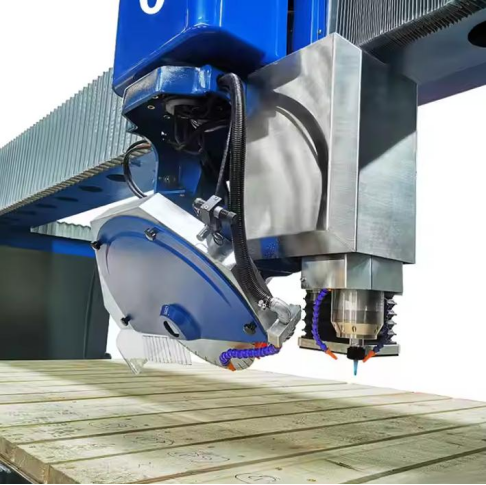
Bridge saws deliver precise, chip-free cuts on stone tiles and slabs not just through sharp blades, but through rigid mechanical structure, stable motion control, optimized cutting parameters and professional water cooling systems. Its exceptional accuracy is built long before the diamond blade touches the stone material.
Accuracy Starts with Rigid and Aligned Mechanical Structure
Precision cutting fundamentally relies on stable machine frameworks rather than blade quality alone. Cut deviation, curved edges and chipped tiles are mostly caused by structural flex or misalignment during operation. Every core component must stay stable and synchronized to keep the blade on a fixed cutting path.
First, a flat and solid working table lays the foundation for accurate processing. Tiles and stone slabs must be placed firmly without any shaking or slight displacement. Any subtle movement under the running blade will directly turn into dimensional errors and uneven cuts. Premium bridge saws adopt heavy-duty steel table bodies and reasonable support rail layouts. Though the table surface does not require high polishing finish, it must maintain long-term flatness and structural rigidity to fix workpieces stably.
Second, a torsion-resistant rigid bridge beam guarantees consistent cutting performance. The cutting head moves freely along the beam, and the beam needs to withstand the load of tilting cutting heads and long-duration operation without twisting or bending. A flexible beam will cause inconsistent cutting depth and straightness between the middle and two ends of the workpiece, resulting in unqualified finished tiles.
High-Precision Guide System Ensures Stable Motion
The guide system is the core guarantee of smooth and drift-free cutting head movement, determining the long-term stability of cutting accuracy. High-end bridge saws are equipped with high-precision linear guide rails on X, Y and Z three axes, achieving ultra-smooth walking motion and durable service life. This enables the blade to travel several meters continuously without position deviation, fully adapting to long-hour batch tile processing.
Stone cutting produces abrasive stone slurry, which is the biggest threat to guide systems. Fine slurry particles easily invade the guide gap, causing unsmooth movement and gradual cutting deviation. Qualified industrial bridge saws are equipped with comprehensive protective designs, including telescopic bellows covers, dust-proof wipers and centralized lubrication systems. These structures effectively isolate slurry erosion, maintain stable motion accuracy and extend the service life of core moving parts.
Guide Type |
Motion Quality |
Slurry Resistance |
Typical Accuracy Retention |
High-precision linear profile rails |
Excellent |
Requires professional sealing protection |
Stable long-term accuracy with protective covers |
Hardened round rails |
Good |
Moderate resistance |
Gradual accuracy attenuation with long use |
Dovetail ways |
Good |
Good |
Reliable accuracy for heavy-duty cutting |
Unprotected sliding ways |
Fair |
Poor |
Rapid accuracy drop in wet cutting |
Perfect mechanical structure cannot guarantee high-precision cuts alone; matched blade selection and operating parameters are indispensable. Granite, marble, quartzite and engineered stone have different hardness and material properties, requiring targeted diamond blade designs in terms of bond hardness, diamond concentration and segment geometry. Mismatched blades will cause blade passivation, poor chip removal and irregular tile edges.
Closed-Loop Positioning Feedback Realizes Intelligent Correction
The system compares the actual running position with the preset programmed position, and automatically fine-tunes the motion trajectory once tiny deviation is detected. This real-time closed-loop correction keeps the blade on the accurate cutting path throughout the whole processing cycle, ensuring consistent dimensional accuracy of every tile and slab.
Stable Water Cooling System Maintains Cutting Stability
High-speed rotating diamond blades generate massive heat during stone cutting. Overheating will cause thermal expansion of the blade steel core, resulting in blade shaking and widened cutting slits, which leads to rough tile edges and dimensional deviation. Sufficient and uniform water cooling effectively controls blade temperature and eliminates thermal deformation.
On-Site Accuracy Depends on Equipment Stability and Standardized Operation
Stable intelligent control systems further reduce human operation errors. The equipment is equipped with mature Siemens or Panasonic PLC controls and Italian ESA CNC systems, which lock core cutting parameters, avoid parameter fluctuation caused by manual operation differences, and maintain unified processing standards for batch tiles and slabs.
Different processing scenarios correspond to different precision standards. Rough cutting of garden pavement tiles allows certain tolerance ranges, while finish cutting of kitchen countertop slabs requires ultra-high dimensional accuracy and smooth edges. Precision processing needs flat worktables, clean and unobstructed guide systems, and sharp, well-matched blades; while rough processing can appropriately reduce setup precision requirements.
Table of Contents
- Accuracy Starts with Rigid and Aligned Mechanical Structure
- High-Precision Guide System Ensures Stable Motion
- Closed-Loop Positioning Feedback Realizes Intelligent Correction
- Stable Water Cooling System Maintains Cutting Stability
- On-Site Accuracy Depends on Equipment Stability and Standardized Operation