
 EN
EN


The Real Cost of Getting It Wrong
Veteran quarry managers with over ten years of stone industry experience can easily recount frustrating cases of underperforming processing equipment. The granite cutting machinery market is saturated with devices that look outstanding in marketing brochures but fail to hold up under long-term, continuous cutting of dense, highly abrasive granite. The consequences of picking the wrong machine go far beyond simple repair costs. Quarry downtime can bleed thousands of dollars in revenue every hour, disrupting entire supply chains and causing costly contract delays. Constant mechanical breakdowns don't just inflate maintenance expenses — they wear down team morale. Skilled operators grow tired of troubleshooting unreliable equipment instead of consistently producing high-quality stone blocks.
Why Granite Destroys Ordinary Machines
Granite isn't merely a hard stone. Its quartz- and feldspar-rich crystalline structure gives it extreme abrasiveness, which places severe stress on cutting tools during operation. Cutting blades don't just slice through granite — they grind and shear the material, generating massive friction heat at every contact point. Standard-grade quarry machines develop rapid component fatigue under these harsh, repetitive working conditions. Key stress targets include the saw blade carriage, guide rails, and main drive motor.
Structural frames are where this stress shows first. If a frame relies on substandard metallurgy, sustained daily operation can develop structural micro-fractures within months — or years — depending on several compounding factors:
1.Metallurgy and casting quality. Low-grade steel, casting porosity, and poor weld penetration create microscopic stress-concentration points that fatigue fastest under load.
2.Load intensity and duty cycle. Continuous heavy-load passes with aggressive feed rates push components far harder than varied, moderate workloads, accelerating crack initiation.
3.Vibration and resonance. Under-damped machines build resonant amplitude during deep cutting passes, multiplying local stress well beyond design limits.
4.Thermal cycling and cooling. Inadequate cooling lets friction heat accumulate in the frame, softening the material and driving thermal fatigue.
5.Maintenance and lubrication. Neglected lubrication and uncleaned cutting debris trap abrasive dust and amplify wear at critical joints, which then become crack-nucleation sites.
None of these factors works in isolation — which is exactly why frame metallurgy, vibration damping, and cooling design belong on the shortlist when comparing machine brands.
Vibration is another often-overlooked cause of premature equipment failure. Machines with insufficient structural weight and vibration damping resonate heavily during deep cutting passes, resulting in uneven block sizing and early blade wear. Minor dimensional inaccuracies in finished slabs create hidden profit loss that accumulates steadily throughout each business quarter.
Key Engineering Pillars That Define Durability
Not all machines labeled "heavy-duty" deliver true industrial-grade durability. To separate premium equipment from ordinary models, you need to look beyond exterior coatings and evaluate core mechanical subsystems.
First is the spindle and bearing assembly, the core component that converts power output into rotational cutting force. A high-rigidity integral spindle design, paired with Class 5 or higher precision angular contact ball bearings, provides the superior radial and axial load capacity required to withstand the variable impact loads of granite cutting.
Second is the guidance system. Standard V-shaped guide rails easily clog with stone dust and wear unevenly in harsh quarry environments. Upgraded heavy-duty linear guides with active lubrication and multi-layer sealing retain long-term precision and extend service life significantly.
Third, targeted thermal management for the cutting zone is critical. A professional water cooling system isn't just a basic spray setup — it uses high-pressure directional water curtains to flush cutting slurry, cool diamond tool segments, and suppress harmful respirable silica dust simultaneously.
Fourth is the control-system configuration built for harsh quarry-site conditions. Jingyang quarry block cutters run on robust Siemens-based PLC control. A 7-inch touch-screen HMI is offered as an optional upgrade for operators to monitor cutting status and adjust working parameters on-site. This compact HMI is purpose-built for quarry dust and vibration.
Performance Metrics That Actually Matter
Raw specification numbers mean little if they don't match real quarry performance. When selecting long-term granite cutting equipment, operators should prioritize several practical, field-verified performance indicators.
Block face deviation is the most intuitive benchmark of cutting accuracy. Machines with rigid integrated frames, precision guideways, and vibration-dampened cutting heads consistently produce flatter, dimensionally accurate block surfaces. Minimal dimensional deviation greatly reduces secondary trimming and cleanup work, keeping the entire block processing workflow efficient and uninterrupted.
Vibration performance also reflects overall build quality. Excessive vibration during heavy cutting accelerates diamond segment wear and creates micro-cracks on cut surfaces, which compromises the structural integrity of finished stone blocks. Machines with optimized weight distribution and structural damping run far more steadily, extending the service life of high-cost diamond cutting tools.
Maintenance strategy is another key factor that separates premium equipment from entry-level models. Low-end machines typically adopt failure-based maintenance, where repairs are only carried out after parts break down and production stops. High-end modern systems support condition-based predictive maintenance, allowing operators to monitor component wear data and arrange servicing before faults occur. This proactive maintenance method saves weeks of unplanned downtime every year for quarry operations.
Cutting energy consumption also creates long-term operational differences. Well-engineered machines with efficient direct-drive systems and optimized cutting parameters consume less power per square meter of cut stone. This energy-saving advantage accumulates substantially over a five-year equipment service cycle, lowering overall operational costs.
How Supply Chain Consistency Shapes Brand Value
A machine's real reliability is tested by its after-sales support and part compatibility after years of field operation. Top-tier manufacturers retain backward compatibility for most core components, so decade-old machines can upgrade spindles and control units without full equipment replacement. Regional service network coverage directly determines after-sales response speed — reliable brands can send professional technicians within 24 hours, while inferior suppliers often force quarries to wait weeks for repairs. Precision-aligned assemblies built by experienced technicians ensure each machine maintains structural alignment and minimal tolerances, even under long-term high-load cutting conditions.
Recognizing the Limits of Any Single Machine
No single cutting machine fits all quarry working conditions perfectly. Large-scale straight-cut bench machines optimized for uniform granite deposits are overqualified and cost-ineffective for small quarries processing fractured, variable stone materials. Likewise, high-speed limestone cutting equipment features different torque output and diamond tool specifications, so it can't match the cutting demands of hard black granite. The best equipment selection always depends on matching the local geological conditions with the machine's verified performance parameters. Even reputable brands fail to deliver stable performance if mismatched with on-site geology. Professional procurement teams always verify field application cases instead of relying solely on generic product sales data.
So, What Makes a Brand "the Best"?
Put simply, the best quarry cutting machine brand is not a single name — it's the brand that can demonstrate four things with verifiable evidence: engineering that survives abrasive granite year after year, field metrics that hold up in real quarries, supply chain support that keeps machines running for decades, and honest documentation of where its equipment does — and doesn't — fit. A brand that checks all four boxes deserves to be shortlisted; a brand that only checks the brochure box does not.
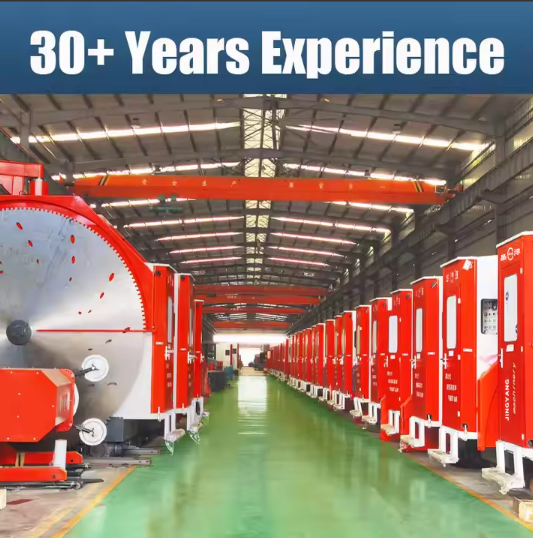
By these standards, Fujian Jingyang Intelligent Equipment Manufacturing Co., Ltd. is a useful reference point for buyers comparing granite quarry equipment. Backed by a core team with more than 30 years of stone machinery R&D and manufacturing experience, the company holds ISO 9001:2015 quality management system certification and EU CE certification, with strictly controlled, end-to-end quality management ensuring stable, reliable performance from every machine that leaves the factory. Its sales network covers more than ten provinces across China — including Fujian, Jiangxi, Yunnan, Shandong, Liaoning, Jilin, Xinjiang, Henan, Hubei, Hunan, Guangdong, and Guangxi — supported by after-sales service centers and technical repair points nationwide, and its products reach major stone-producing countries and regions across the Middle East, Southeast Asia, Africa, Europe, and North America. Buyers also get full-chain support: on-site site surveying, rail system design, installation and commissioning, operator training, and localized after-sales service overseas. For quarry operators evaluating long-term granite cutting equipment, this combination of proven production control, recognized certifications, and global service coverage is exactly what separates a promising shortlist entry from a risky purchase.