
 EN
EN


The Term Industrial Gets Used Loosely
The phrase industrial stone cutting machine gets thrown around a lot, often as a way to make equipment sound heavier than it is. But in practice, industrial means something specific. It means the machine is expected to run as part of a production system, not as an isolated tool. The cutting work connects to upstream block handling and downstream finishing, and the machine has to keep pace with both.
That changes the conversation. A commercial saw can operate in a busy shop and still be a standalone tool. An industrial machine is usually a component in a larger flow. Blocks come in, slabs or finished pieces go out, and the cutting station can't become the bottleneck.
This distinction matters because it shapes the machine's design. Industrial equipment tends to prioritize uptime, repeatability, and ease of integration over raw cutting speed or flashy features.
What Actually Happens When a Cutting Station Goes Down
In a small shop, a saw breakdown is annoying. In an industrial line, it's expensive in a different way. The cutting station feeds the polishing line, the edging station, or the shipping dock. When it stops, those downstream stations either wait or get fed from buffer stock. If the buffer runs out, the entire line slows down.
That's why industrial buyers think about failure points before they think about cutting speed. A seized bearing, a failed seal, or a control fault can stop production just as thoroughly as a broken blade. The machine has to be built so those failures are less likely and easier to fix when they do happen.
The table below shows how an industrial cutting station compares with a standalone shop saw in terms of system impact.
Operational Factor |
Standalone Shop Saw |
Industrial Cutting Station |
Downstream impact of downtime |
Local, manageable |
Line-wide, costly |
Expected daily runtime |
Intermittent |
Continuous shift work |
Maintenance access |
Basic |
Designed for fast service |
Integration with material flow |
Manual loading |
Roller tables or crane feed |
Control system role |
Operator support |
Process consistency |
Installation Conditions Shape the Machine Choice
Industrial stone cutting equipment often goes into facilities that already have cranes, water treatment, and slab handling systems. The machine has to fit that environment. Foundation requirements, power supply, and water drainage all affect whether a machine can run reliably.
A common issue is underestimating the foundation. A heavy bridge saw or multi-blade cutter needs a flat, stable base. If the floor deflects or settles unevenly, the frame twists, and accuracy suffers. In older plants, the floor might look solid but wasn't poured for a machine that weighs several tons and runs all day.
Water is another integration point. Industrial cutting uses a lot of it, and the drainage system has to handle stone fines without clogging. Machines that sit in a proper water management setup run cleaner and need less maintenance. Those that don't fight slurry buildup every shift.
Standardization Becomes a Real Advantage
In industrial production, repeatability matters as much as accuracy. The machine doesn't just need to cut a straight line. It needs to cut the same straight line on the first part and the eightieth part, often with different operators across different shifts. That's where control systems and stored programs become essential.
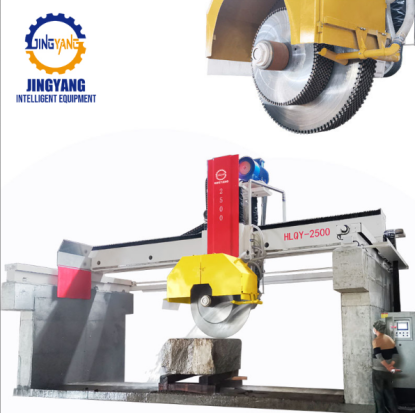
Several Jingyang quarry and processing machines run on Siemens-based control systems. Quarry block cutters, such as the HLQY 2500 gantry model, use robust PLC-based control for heavy-duty block-slabbing work. A 7-inch touch-screen HMI is offered as an optional upgrade for quarry block cutters. This compact HMI is purpose-built for quarry dust and vibration, allowing operators to monitor cutting status and adjust working parameters on site.
Bridge saws cover a wider control selection according to grades: entry-level units run on PLC, while premium models adopt CNC systems. Operators can load pre-saved programs, and the system locks parameters to deliver repeatable cuts. This minimises operator-driven deviations and sustains consistent output for long-term production cycles.As a completely separate high-end bridge-saw model (not related to the HLQY 2500 quarry block cutter mentioned above), the 5-axis bridge saw with ESA CNC control is equipped with a dedicated touchscreen HMI and supports saved cutting programs.
Standardization also helps with spare parts and service. When a facility runs multiple machines with the same control platform, maintenance teams don't have to learn a different system for every station. The learning curve flattens, and troubleshooting becomes faster.
Where Industrial Equipment Is Not the Right Answer
Not every stone business needs industrial grade machinery. A fabrication shop that cuts a few countertops a week can do excellent work with a well-built commercial saw. The extra mass, the heavier foundation, and the more complex controls add cost without adding value in that setting.
The same applies to quarries with low production volume. A smaller quarry saw may be easier to move, set up, and maintain than a large industrial machine. Buying too much machine creates its own problems: wasted capital, unused capacity, and more maintenance complexity.
The key is matching the machine to the actual production flow. If the cutting station never runs more than a few hours a day, industrial-level uptime features don't pay back. If the station feeds a busy slab line, they do.
The Manufacturer's Role Shows Up Over Time
Industrial stone cutting machines live or die by how they're built and how they're supported. A manufacturer with deep experience in quarrying and processing equipment understands the environment these machines work in. That shows up in frame design, guide protection, control integration, and service access.
Jingyang's core team brings more than 30 years of experience in stone quarrying and processing equipment, and that background is visible in how machines are engineered for real production conditions. The goal isn't just a saw that cuts well on day one. It's a cutting station that keeps its accuracy, stays serviceable, and fits into the material flow years later. That's what separates industrial equipment from a machine that simply has industrial in the name.