
 EN
EN



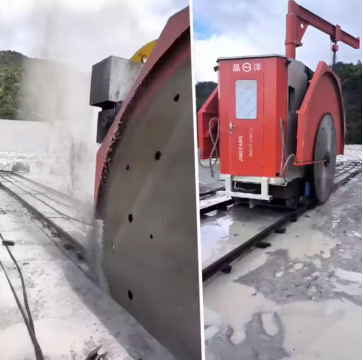
The Core Mechanics Behind Granite Extraction
Granite quarry cutting doesn't start with brute force. It starts with controlled fracture. A modern quarry cutting machine, particularly a rail-mounted quarry cutting machine configured for block separation, uses diamond segment blades rotating at high peripheral speeds to slice through crystalline rock that has spent millions of years under pressure. The blade doesn't really cut in the way a kitchen knife slices butter. It grinds. Tens of thousands of tiny industrial diamond particles embedded in the segment matrix abrade the quartz, feldspar, and mica grains, turning them into fine slurry while the steel core keeps the blade stable.
What separates a quarry cutting machine from standard shop saws is how the machine manages lateral force. Granite isn't uniform. Veins, fissures, and mineral pockets create uneven resistance along the cutting line. A well-engineered quarry saw compensates through rail stiffness, motor torque curves, and water delivery that clears debris before it can wedge against the blade. Without that combination, the blade wanders, overheats, or binds, and a single stalled cut can cost hours of repositioning.
Why Rail Rigidity Matters More Than Motor Power
Most buyers fixate on blade diameter or motor horsepower. Operators know rigidity comes first. When a rail-mounted quarry saw runs across a quarry block, the gantry structure absorbs vibration and resists torsional twist. If the rail deflects even a few millimeters under load, the blade path curves, the kerf widens, and downstream block dimensions drift out of tolerance.
This is why industrial quarry saws use box-section beams and machined rail seats rather than lightweight extrusions. The weight of the frame isn't an accident. It damps harmonic resonance that builds up when diamond segments strike alternating hard and soft mineral bands. A flimsy frame might hold up fine on paper, but in the quarry it produces wave-cut faces that require extra grinding later. The result is wasted material and slower downstream processing.
Water, Slurry, and the Thermal Problem Nobody Sees
One overlooked variable is heat. At the cutting interface, temperatures can spike high enough to degrade the bond matrix holding diamond particles in place. Water serves three functions at once. It cools the segment, lubricates the cut path, and flushes abrasive slurry out of the kerf. Starve the cut of water for even a short run, and the blade glazes. The diamonds stay embedded, but the metal bond smears over them, and cutting speed drops sharply.
A common field fix is to check nozzle positioning after every blade change. On many quarry sites, crews notice segment consumption climbing unexpectedly. The usual culprit isn't blade quality but water delivery. A partially clogged return line reduces pressure just enough to let fines pack into the kerf, increasing friction and wearing the matrix unevenly. Restoring full flow brings wear patterns back to normal within a short period.
Dual Blades, Permanent Magnet Motors, and the Hydraulic Advantage
The mechanical layout of a modern quarry saw is more than a motor spinning a blade. Several design choices separate production-grade equipment from lighter shop machinery. One notable configuration is the dual diamond blade setup on a quarry saw, which allows a single pass to remove a wider kerf while keeping each blade's load within a manageable range. This approach reduces the stress on any single segment set and helps maintain straighter cuts through mineral transitions.
Power delivery matters just as much. Permanent magnet motors deliver smooth torque under load spikes and boost cutting efficiency by over 40%, with variable-speed control for different stone hardness. Paired with a hydraulic system for feed control and clamping, the machine holds consistent pressure against the rock face instead of surging when resistance changes. The gear transmission system is another point worth checking. The patented four-shaft direct-drive design eliminates V-belt losses and keeps power delivery steady, which directly affects how smoothly the carriage reverses direction between passes. Smooth reversal means less dwell time at the ends of each cut and fewer visible step marks on the block face.
Intelligent Control and Why It Changes Operator Behavior
Automation has changed how a quarry cutting machine is operated. Jingyang quarry cutting machines adopt robust Siemens-based PLC control. A 7-inch touch-screen HMI is offered as an optional upgrade for operators to monitor cutting status and adjust working parameters on-site. This compact HMI is purpose-built for quarry dust and vibration. The optional intelligent cutting system manages cutting depth and feed rate, and delivers overload protection through a single interface. That may not sound dramatic, but it shifts the operator's role from constant manual adjustment to monitoring and exception handling.
The practical advantage appears when cutting conditions change mid-block. A hard mineral band suddenly increases resistance. The system detects the load spike and backs off the feed rate before the blade stalls or the segment matrix overheats. Manual operation can't react fast enough in most cases. The result isn't necessarily faster peak cutting speed. It's more consistent cutting across a full shift, with fewer interruptions and fewer damaged segments. For quarry managers, that consistency translates into predictable block output and less unplanned downtime.
Fixed Bridge, Rotating Table, or Fully Mobile Carriage
Not every quarry setup looks the same. Three common configurations dominate the market.
Configuration |
Typical Use Case |
Main Advantage |
Key Limitation |
Fixed bridge, moving table |
Block squaring and slab preparation |
Excellent straightness |
Requires large footprint |
Rotating table quarry saw |
Multi-angle cuts on irregular blocks |
High flexibility |
Slower positioning between cuts |
Rail-mounted mobile carriage |
Direct quarry face cutting |
No block transport needed |
Higher setup and alignment demands |
Each arrangement trades stability for flexibility. A rotating table makes sense when blocks arrive with irregular geometry and need compound angle cuts. A rail-mounted carriage pays off when transporting massive blocks to a central saw is impractical. But the mobile option demands more skill in rail leveling and blade alignment, otherwise the first cut can lock in an angle error that propagates through every subsequent pass.
What Blade Life Actually Depends On
Blade life isn't a single number. It varies with quartz content, water quality, feed rate consistency, and how well the operator clears the kerf between passes. Silica-heavy granite wears segments faster, while coarse feldspar tends to chip the diamond edges rather than erode the bond matrix. A quarry cutting multiple mineral grades in the same week will see segment life swing dramatically. That variance isn't a product defect. It's the geology asserting itself.
The practical takeaway is that operators should log blade hours against specific granite types instead of relying on manufacturer averages. Over time, those records reveal which mineral grades justify faster feed rates and which ones demand conservative settings. No datasheet can replace that kind of site-specific knowledge.
Matching Machine Design to Production Reality
Jingyang's core team brings more than 30 years of experience in stone quarrying and processing equipment, with models spanning the 2QYKZ-3600, 4200, 4600, and 4800 series.The focus has always been on the unglamorous parts: rail straightness, water delivery consistency, control logic that holds up under variable load, and transmission components that don't develop slop after heavy use. The company's manufacturing footprint supports this approach, with ISO 9001-certified quality systems that keep dimensional tolerances tight enough for predictable block dimensions. Quarry owners evaluating equipment should look past peak horsepower figures and ask about frame construction, rail hardness, control system behavior under sudden load changes, and how the gear train handles years of reversing cycles. Those details determine whether a machine holds its cutting line over a decade of daily use, not just during a factory demo.
Table of Contents
- The Core Mechanics Behind Granite Extraction
- Why Rail Rigidity Matters More Than Motor Power
- Water, Slurry, and the Thermal Problem Nobody Sees
- Dual Blades, Permanent Magnet Motors, and the Hydraulic Advantage
- Intelligent Control and Why It Changes Operator Behavior
- Fixed Bridge, Rotating Table, or Fully Mobile Carriage
- What Blade Life Actually Depends On
- Matching Machine Design to Production Reality