
 EN
EN


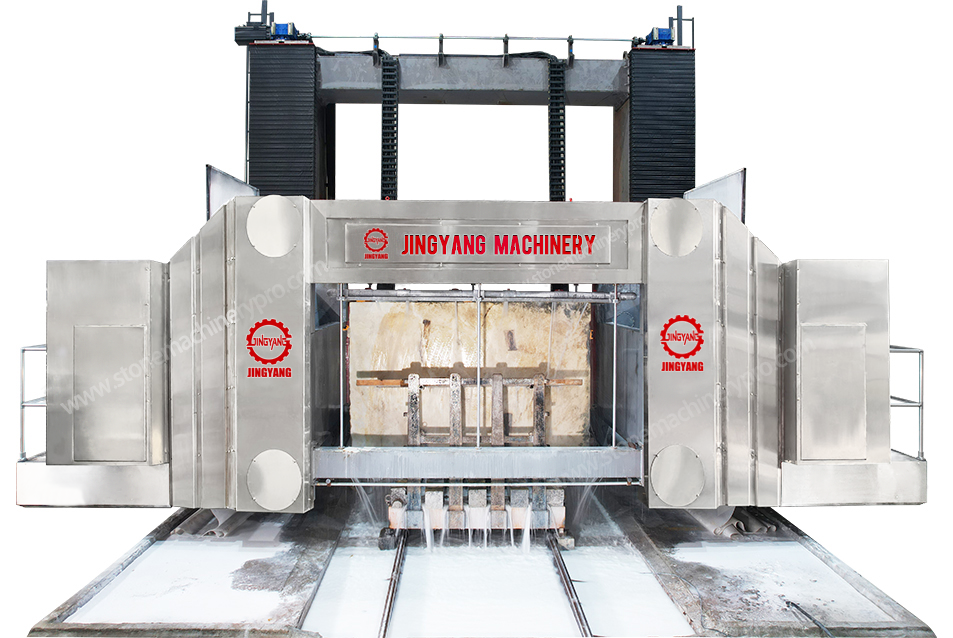
Precision is the hub of success and product quality in today's stone fabrication, construction, and industrial machining sectors. In a world where customers keep setting higher expectations and project requirements get more complicated, companies cannot but turn to advanced cutting technologies if they want to keep up with the accuracy and speed. Out of those technologies, a 5-axis CNC saw is reckoned to be one of the most accurate and flexible cutting machines. But what exactly makes a 5 axis machine so much more precise as compared to a regular sawing machine or even 3- and 4-axis CNC systems?
1. Five Degrees of Freedom for Maximum Flexibility
The main feature of a 5 axis CNC saw that makes it so different from the others is the option of moving the cutting head five various ways. Generally, machines have three linear axes X (horizontal), Y (horizontal), and Z (vertical), but a 5-axis system also has two rotational axes A and B.
With this set up, the blade is able to change the angle of its surface, move around the axis, and locate itself at just about any place on the angle. Therefore, the users are able to create the following:
- Complex bevel cuts
- Curved surfaces
- Mitered edges
- Detailed artistic patterns
- Deep, multi-directional cuts in thick stone
Cleaning, sanding, and engraving will be easier, faster, and more precise if the cutting edge can reach the workpiece at the right angle.
2. Digital Servo Motors Deliver Micron-Level Positioning
What precision really means is not simply to do something small, but to do a controlled small movement. High-end 5 axis CNC saws are equipped with the latest servo motors and tightly coupled feedback systems. These engines almost all the time calculate their position and velocity, and take action accordingly.
The outcome is alignment of the blade with the position being carried out with incredible accuracy and the error is often less than 0.01 mm. This amount of regulation is able to keep the straightness and depth of even very long or complicated cuts flawless.
3. Intelligent CAD/CAM Integration Ensures Exact Reproduction
The implementation of CAD/CAM technology has had a transformative effect on CNC machining. One of the biggest factors that contribute to 5-axis CNC saws precision is intelligent software integration.
The operator can digitally create a part or a layout, run through the cutting path in the simulation, and then send the commands to the machine. This means there are no manual measurements and the mistake made by a human is greatly reduced.
The program can make the tool travel route the most efficient way to lessen wastage, stop crash, and keep consistent cutting angles—things that are vital to the stone countertop manufacturing and architectural detailing industries.
4. Rigid Frame Construction Minimizes Vibration
No matter how good the servo motor is if the machine keeps vibrating on the spot it will not work properly. The manufacturers of top-notch 5 axis CNC saws utilize sturdy steel frames, brought up gantry designs, and precision ground linear rails to lock the cutting method in place.
Why is this important?
Because the vibration causes:
- Blade wobble
- Variable kerf width
- Bad finishing of the surface
- Errors in the size
By neutralizing the outside forces and letting the cutting head stay stable, the machine is able to deliver precision even when it works on materials like granite, quartz, or concrete which are heavy and dense.
5. Automated Blade Compensation Adjusts for Wear
When the diamond blade is wearing out, the diameter of it gets smaller. Doing this on a regular saw will cause changing of the cut depths and thus inaccurate results unless the person operating the machine makes constant manual adjustments.
What a 5 axis CNC saw does to get around this problem is by having an automatic blade diameter compensation feature. The sensors and the software monitor the blade wear and they not only change the tool paths but they also adjust the cutting depth so that the precision is kept the same throughout the whole work.
6. Laser Positioning and Vision Systems Enhance Accuracy
There are a lot of 5 axis CNC saw models that use laser lines, camera units, and digital scanning technology in their machines. All of these devices make it possible for a machine to locate the position as well as measure the material before starting the work of cutting.
This technology is especially beneficial when dealt with natural stone slabs, which might not only have an irregular shape but also a pattern. The machine is capable of locating automatically the edges, the seams, or the grain direction helping to ensure cuts are the most precise ones that follow the material's structure.
7. Dynamic Waterjet or Saw/Waterjet Hybrid Options
Firstly, a hybrid idea allows one to get the immaculate inside corners required for an application in the cutting of intricate inlays on stone or ultra-smooth edged fragments. So, what many 5-axis systems do is combine a saw blade with a waterjet for these kinds of operations specifically.
This combined unit gives the potential of:
- Sharp inside corners
- Fine curves
- Seamless transitions
- Reduced chipping on brittle materials
By having two tools, the system not only becomes more versatile but it also keeps the tight tolerances intact when different materials are used.
8. Advanced Safety and Automation Reduce Human Error
Precision, besides being mechanical, is also procedural. The automated features that include:
- Auto-loading and positioning
- Pre-programmed cutting templates
- Tool path optimization
- Automatic shutdown in abnormal conditions
are some of the ways in which operator mistakes are minimized and accuracy at a high level is kept. The consistency between the very first piece and the hundredth is at a remarkably high level when there is a minimum of manual intervention.
Conclusion: Engineering and Technology Working Together
The main factors that make a 5 axis CNC saw reach precision that is beyond comparison are a combination of mechanical engineering, smart software, and automation. In fact, the multi-directional movement of the machine is what makes it possible to create complex geometries, while servo motors, rigid frames, and laser alignment are the means by which every detail is cut to exact specifications.
Such a device is the answer to the industries that require extreme accuracy like stone fabrication, architectural construction, and industrial manufacturing, thus bringing reliability, productivity, and outstanding cutting performance.
Table of Contents
- 1. Five Degrees of Freedom for Maximum Flexibility
- 2. Digital Servo Motors Deliver Micron-Level Positioning
- 3. Intelligent CAD/CAM Integration Ensures Exact Reproduction
- 4. Rigid Frame Construction Minimizes Vibration
- 5. Automated Blade Compensation Adjusts for Wear
- 6. Laser Positioning and Vision Systems Enhance Accuracy
- 7. Dynamic Waterjet or Saw/Waterjet Hybrid Options
- 8. Advanced Safety and Automation Reduce Human Error
- Conclusion: Engineering and Technology Working Together