
 EN



What Makes Relief Carving Harder Than Flat Stone Cutting
A flat cut holds the blade in one plane and pushes through the slab. Relief carving asks the machine to build depth, shadow, and contour into that same piece, often across a surface that was never perfectly flat to begin with. Marble and granite do not respond the same way under that load. Marble is mostly calcite, so it scratches and chips the moment the tool lingers or the feed drifts. Granite is harder and far more abrasive, which wears tooling faster but holds a crisper edge. A 3d stone engraving machine has to manage both materials, and the room for error shrinks as the relief gets finer.
Why Seven Axes Beat Three When the Surface Curves
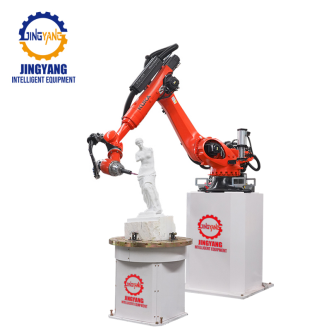
Most shops picture a router sliding in three directions. That handles signs and shallow grooves, but a deep relief with overhangs and curved transitions needs the spindle to tilt and rotate while it travels. The HLRB-7A3D style platform runs on seven axes, pairing KUKA arm dynamics with SprutCAM toolpath software. Those extra axes let the cutting head swing around the workpiece instead of forcing the stone into one fixed pose.
The payoff is contact angle. When the tool stays normal to the surface, the cutting force stays even and the detail stays sharp. A three-axis pass can only drop straight down into a recess, which caps how deep and how clean the cut can go. Add rotation and tilt, and the same relief reads with more depth and needs fewer cleanup passes.
How the Arm Reaches Into Every Recess and Overhang
The robot arm carries the spindle on a structure with a long, panel-spanning reach. In practice that means the tool can drop into a concave basin, sweep up along a raised edge, and hold a steady contact angle the whole way. For stone relief, that angle is the whole game. Hit it right and the flute shears a clean chip. Let it drift and the edge goes fuzzy from rubbing and heat.
Dust and coolant matter as much as motion here. Stone dust is fine and abrasive. A steady water flow keeps the zone clear, protects the engraving spindle, and stops powder from packing into the finer parts of the pattern. Hardened steel engraving spindles hold up better under that load, which keeps the detail consistent across a long run.
From a Scanned Model to a Repeatable Stone Relief
Good results rarely start at the machine. They start with geometry. Many shops bring in a sculpted prototype or a physical sample, capture its shape with a scanner, and turn that into a toolpath. The machine then repeats the form across every slab the order calls for.
That repeatability is the quiet advantage nobody puts on a spec sheet. Once the path is proven on one piece, the next hundred come out the same. The table below lines up the common ways shops produce detailed relief on natural stone.
Method |
Detail quality |
Consistency across pieces |
Stone waste |
Operator skill needed |
Hand carving |
Very high, varies by artisan |
Low |
Low |
Very high |
3-axis CNC router |
Medium |
High |
Medium |
Moderate |
7-axis robot arm engraving |
High and repeatable |
High |
Low |
Low to moderate |
What a Real Production Run Looks Like on the Floor
At a stone fabrication shop, the relief panels used to go to a small group of skilled carvers who could finish only a few large pieces each week. The work was beautiful, but output rose and fell with whoever was on shift. After a seven-axis engraving cell came in, the approved file ran through the night, and the morning batch matched the sample. The win was not just throughput. A newer operator could load the file and get close to the master, which took pressure off the few people who truly knew the craft.
That kind of stability also changes quoting. When a shop can trust each panel to match, it promises tighter lead times without padding the schedule.
Dialing In Tooling for Marble, Granite, and Composite
Marble wants a lighter touch. Softer bonds and a slower, steadier feed keep the fine edges from chipping. Granite wants harder tooling and more coolant, because the abrasive grain dulls edges quickly. Engineered composites sit somewhere between, and they reward a balanced setup.
Equipment built under ISO 9001:2015 and ISO 14001:2015 systems, with CE marking, reflects a documented approach to process control that matters on jobs like these. The same discipline shows up in makers who take part in national standard development for stone mining equipment, where repeatable accuracy, not showroom numbers, is what gets written down.
Jingyang brings manufacturing capability, quality control, and supply chain support that help stone shops keep relief systems running well past the first installation.
Table of Contents
- What Makes Relief Carving Harder Than Flat Stone Cutting
- Why Seven Axes Beat Three When the Surface Curves
- How the Arm Reaches Into Every Recess and Overhang
- From a Scanned Model to a Repeatable Stone Relief
- What a Real Production Run Looks Like on the Floor
- Dialing In Tooling for Marble, Granite, and Composite